Actionable Gamification: Beyond Points, Badges and Leaderboards - Yu-Kai Chou
— books, product & design — 143 min read
About the book

- Buy on Amazon
- Goodreads reviews
- Pages: 506
Personal Summary
- Read Chapter 3, understand the Octalysis Framework with 8 Core Drives, Left & Right Brain Core Drives, White & Black Hat Core Drives
- Read Chapter 17: Designing a project from scratch with Octalysis for the steps to follow in an project
- Refer to this sheet Game Techniques or each chapter's Game Techniques sections
Table of Contents
- Chapter 1: When the Surreal Blends into our World
- Chapter 2: The PBL Fallacy
- Chapter 3: The Octalysis Framework
- The 8 Core Drives of Gamification
- Core Drive 1: Epic Meaning & Calling
- Core Drive 2: Development & Accomplishment
- Core Drive 3: Empowerment of Creativity & Feedback
- Core Drive 4: Ownership & Possession
- Core Drive 5: Social Influence & Relatedness
- Core Drive 6: Scarcity & Impatience
- Core Drive 7: Unpredictability & Curiosity
- Core Drive 8: Loss & Avoidance
- Left Brain vs. Right Brain Core Drives
- White Hat vs Black Hat Gamification
- The Hidden Ninth Core Drive: Sensation
- How to Apply Level I Octalysis to Actual Systems
- Quick Intro to Level II Octalysis and Beyond
- The 8 Core Drives of Gamification
- Chapter 4: Putting Gamification in its Place
- Chapter 5: The First Core Drive – Epic Meaning & Calling
- Chapter 6: The Second Core Drive – Development & Accomplishment
- Chapter 7: The Third Core Drive – Empowerment of Creativity & Feedback
- Chapter 8: The Fourth Core Drive - Ownership & Possession
- Chapter 9: The Fifth Core Drive - Social Influence & Relatedness
- Chapter 10: The Sixth Core Drive: Scarcity & Impatience
- Chapter 11: The Seventh Core Drive Unpredictability & Curiosity
- Chapter 12: The Eighth Core Drive - Loss & Avoidance
- Chapter 13: Left Brain vs Right Brain Core Drives
- Chapter 14: The Mysteries of White Hat and Black Hat Gamification
- Chapter 15: Understanding Other Gamification and Behavioral Frameworks with Octalysis
- Chapter 16: Level I Octalysis in Action
- Chapter 17: Designing a project from scratch with Octalysis
- The Octalysis Strategy Dashboard
- Define Business Metrics
- Define User Types
- Define Desired Actions
- Define Feedback Mechanics
- Incentives and Rewards
- Level I Octalysis Ideation Process
- Core Drive 1: Epic Meaning & Calling
- Core Drive 2: Development & Accomplishment
- Core Drive 3: Empowerment of Creativity & Feedback
- Core Drive 4: Ownership & Possession & Feedback
- Core Drive 5: Social Influence & Relatedness
- Core Drive 6: Scarcity & Impatience
- Core Drive 7: Unpredictability & Curiosity
- Core Drive 8: Loss & Avoidance
- Repeating the Octalysis Process
Chapter 1: When the Surreal Blends into our World
Why Gamification?
Coonradt addressed the question, "Why would people pay for the privilege of working harder at their chosen sport or recreational pursuit than they would work at a job where they were being paid?" He then boiled it down to five conclusions that led to hobbies being more preferable to work.
- Clearly defined goals
- Better scorekeeping and scorecards
- More frequent feedback
- A higher degree of personal choice of methods
- Consistent coaching
Human-Focused Design: The Better Term for Gamification
In my own view, gamification is the craft of deriving fun and engaging elements found typically in games and thoughtfully applying them to real-world or productive activities. This process is what I call "Human-Focused Design," in opposition to what we normally find in society as "Function-Focused Design." Human-Focused Design optimizes for human motivation in a system as opposed to optimizing for pure functional efficiency within the system.
Most systems are inherently "function-focused," that is, designed to get the job done quickly. This is like a factory that assumes its workers will do their jobs because they are required to, not because they necessarily want to perform the associated tasks. However, at its core, Human-Focused Design emphasizes that people aren't rudimentary cogs in a system.
We have feelings, ambitions, insecurities, and reasons for whether or not we want to do certain things. Human-Focused Design optimizes for these feelings, motivations, and engagement as the basic foundation for designing the overall system as well as its functions. (Note: I originally created the term "Human-Focused Design" to contrast with "Function-Focused Design" in 2012, but it should not be confused with "Human Centered Design," or "User-Centric Design" by IDEO5.)
The reason we call this design discipline "Gamification" is because the gaming industry was the first to master Human-Focused Design.
Games have no other purpose than to please the humans playing them. Yes, there are often "objectives" in games, such as killing a dragon or saving the princess. But those are all excuses to simply keep the player happily entertained inside the system, further engaging them enough to stay committed to the game.
The harsh reality of game designers is that, no one ever has to play a game. They have to go to work, do their taxes, and pay medical bills, but they don't have to play a game. The moment a game is no longer fun, users leave the game and play another game or find other things to do.
Since game designers have spent decades learning how to keep people consistently engaged with repetitive activity loops towards purposeless goals, games are a great source of insight and under-standing into Human-Focused Design. Indeed, depending on how you qualify a game (think of chess, hide-and-seek, and Monopoly), you could stretch back centuries to learn what game designers can teach us on creating compelling, playful experiences.
Through gamification, we can look through the lens of games to understand how to combine different game mechanics and techniques to form desired and joyful experiences for everyone.
The Conquests of Gamification
Games have the amazing ability to keep people engaged for long periods of time, build meaningful relationships between people, and develop their creative potential. Unfortunately, most games these days are simply focused on escapism - wasting your life away on something that does not improve your own life nor the lives of others - besides the game makers of course.
Now imagine if there is a truly addictive game, where the more time you spend on it, the more productive you become. You would be playing and enjoying it all day. Your career would improve as your income increased, you would experience better relationships with your family, create value for your community, and solve the world's most challenging problems. That is the promise I believe Gamification can fulfill, and it is the vision I continuously strive for throughout my life.
Chapter 2: The PBL Fallacy
An Obsession with Grunt Work
If you have ever played RPGs (Role-Playing Games) before, you would know that the act of "leveling up" often requires defeating the same monsters over and over again in the same stage for hours on end. Even mobile games like Candy Crush or Angry Birds require the same repetitive action (bird-throwing and gem-matching) for weeks or months in order to level up and progress. In the gaming world, this is appropriately called "grinding," and it is fun and addictive for children and adults alike.
In the real world, this is often defined as "grunt work." Generally, no one likes to do grunt work, and it requires strong work ethic and will power to complete it. But kids, who again are assumed to have no discipline or work ethic, are somehow sacrificing sleep and risking punishment to complete seemingly pointless grunt work for fun.
Why? Because they are excited about leveling their character up. They want to get that extra +5 strength and gain a new game skill to beat a challenging boss that they couldn't defeat until they reached a high enough level. They do it because they see the big picture, the "why" they are doing it. They like that sense of accomplishment, as well as the use of their creativity in developing and optimizing certain strategies. They desire these feelings so much that anything that stands in the way, be it grunt work or otherwise, is worth doing and doing urgently.
Now, imagine a world where there is no longer a divide between what you need to do and what you want to do. Where everything is fun and engaging, and you actually want to wake up each morning to tackle the challenges ahead. Grunt work takes on a new meaning when understood as an affect of powerful motivational factors. This is the promise and vision that good gamification design can create.
The Story of the Good Designer vs. Bad Designer
To understand the core of good gamification design, let's start with an example of how a bad game designer might design a game.
In designing a game, a bad designer might start off thinking, "Okay, what popular game mechanics and game elements should I use? Well, of course we need monsters in the game. We also need swords so where should I place those? How about crops that friends can fertilize? What about some birds that show a lot of attitude? I'm sure people will love it!"
As you can see from the exaggerated depiction above, a game might have all the "right game elements" but still be incredibly boring or stupid if they do not focus on their users' motivations first. It is worth remembering that every single game in the market has what we call game mechanics and game elements. However, most are still boring and are financial losers. Only a few well-designed games become engaging and even addictive. Are you designing your experience to be the failing game or the successful game? How would you know?
So let us look at how a good game designer might tackle the problem. Instead of starting with what game elements and game mechanics to use, the good game designer may begin by thinking, "Okay, how do I want my users to feel? Do I want them to feel inspired? Do I want them to feel proud? Should they be scared? Anxious? What's my goal for their intended experience?
Once the designer understands how she wants her users to feel, then she begins to think, "Okay, what kind of game elements and mechanics can help me accomplish my goals of ensuring players feel this way." The solution may lie in swords, plants, or perhaps word puzzles, but the whole point here is that game elements are just a means to an end, instead of an end in itself. Game elements are simply there to push and pull on their users' behavioral core drives.
Chapter 3: The Octalysis Framework
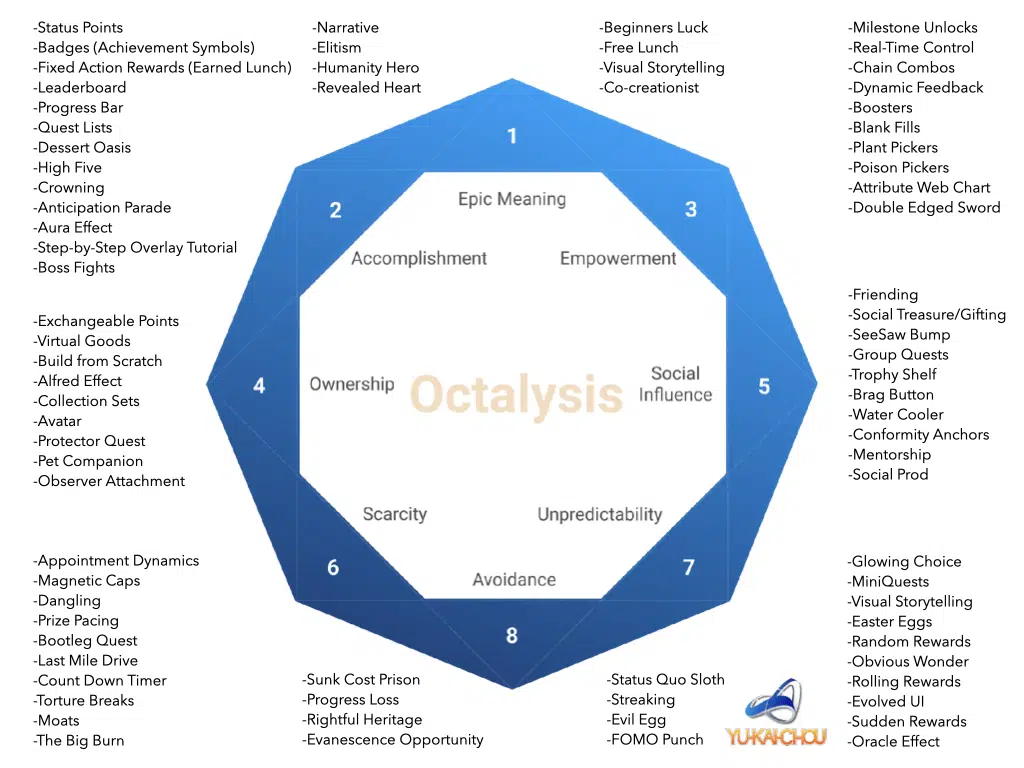
The 8 Core Drives of Gamification
Core Drive 1: Epic Meaning & Calling
Epic Meaning & Calling is the Core Drive that is in play when a person believes they are doing something greater than themselves and/or were "chosen" to take that action. An example of this is when a player devotes a lot of their time to contribute to projects such as Wikipedia. We are familiar with the fact that people don't contribute to Wikipedia to make money, but they don't even do it to pad their resumes. People contribute to Wikipedia because they believe they are protecting humanity's knowledge - something much bigger than themselves. This also comes into play when someone has "Beginner's Luck" an effect where people believe they have some type of gift that others don't or believe they are "lucky" getting that amazing sword at the very beginning of the game.
Core Drive 2: Development & Accomplishment
Development & Accomplishment is our internal drive for making progress, developing skills, achieving mastery, and eventually over-coming challenges. The word "challenge" here is very important, as a badge or trophy without a challenge is not meaningful at all, This is also the core drive that is the easiest to design for and, coincidently, is where the majority of the PBLs: points, badges, leaderboards mostly focus on.
Core Drive 3: Empowerment of Creativity & Feedback
Empowerment of Creativity & Feedback is expressed when users are engaged in a creative process where they repeatedly figure new things out and try different combinations. People not only need ways to express their creativity, but they need to see the results of their creativity, receive feedback, and adjust in turn. This is why playing with Legos and making art is intrinsically fun. If these techniques are properly designed and integrated to empower users to be creative, they often become Evergreen Mechanics: where a game designer no longer needs to continuously add additional content to keep the activity fresh and engaging. The brain simply entertains itself.
Core Drive 4: Ownership & Possession
Ownership & Possession is where users are motivated because they feel like they own or control something. When a person feels ownership over something, they innately want to increase and improve what they own. Besides being the major core drive for the desire to accumulate wealth, it deals with many virtual goods or virtual currencies within systems. Also, if a person spends a lot of time customizing their profile or avatar, they automatically feel more ownership towards it also. Finally, this drive is also expressed when the user feels ownership over a process, project, and/or the organization.
Core Drive 5: Social Influence & Relatedness
Social Influence & Relatedness incorporates all the social elements that motivate people, including: mentorship, social acceptance, social feedback, companionship, and even competition and envy. When you see a friend that is amazing at some skill or owns something extraordinary, you become driven to attain the same. This is further expressed in how we naturally draw closer to people, places, or events that we can relate to. If you see a product that reminds you of your childhood, the sense of nostalgia would likely increase the odds of you buying the product.
Core Drive 6: Scarcity & Impatience
Scarcity & Impatience is the Core Drive of wanting something simply because it is extremely rare, exclusive, or immediately unattainable. Many games have Appointment Dynamics or Torture Breaks within them (come back 2 hours later to get your reward) the fact that people can't get something right now motivates them to think about it all day long. As a result, they return to the product every chance they get. This drive was well utilized by Facebook when it launched: at first it was just for Harvard students, then it opened up to a few other prestigious schools, and eventually all colleges. When it finally opened up to everyone, many people wanted to join simply because they previously couldn't get in.
Core Drive 7: Unpredictability & Curiosity
Unpredictability is the Core Drive of constantly being engaged because you don't know what is going to happen next. When something does not fall into your regular pattern recognition cycles, your brain kicks into high gear and pays attention to the unexpected. This is obviously the primary Core Drive behind gambling addictions, but it is also present in every sweepstake or lottery program that companies run. On a lighter level, many people watch movies or read novels because of this Core Drive. The very controversial Skinner Box experiments, where an animal irrationally presses a lever frequently because of unpredictable results, are exclusively referring to the core drive of Unpredictability & Curiosity - although many have misunderstood it as the driver behind points, badges, and leaderboard mechanics in general."
Core Drive 8: Loss & Avoidance
This Core Drive should come as no surprise - it's the motivation to avoid something negative from happening. On a small scale, it could be to avoid losing previous work or changing one's behavior. On a larger scale, it could be to avoid admitting that everything you did up to this point was useless because you are now quitting. Also, opportunities that are fading away have a strong utilization of this Core Drive, because people feel if they didn't act immediately, they would lose the opportunity to act forever (e.g. "Special offer for a limited time only!")
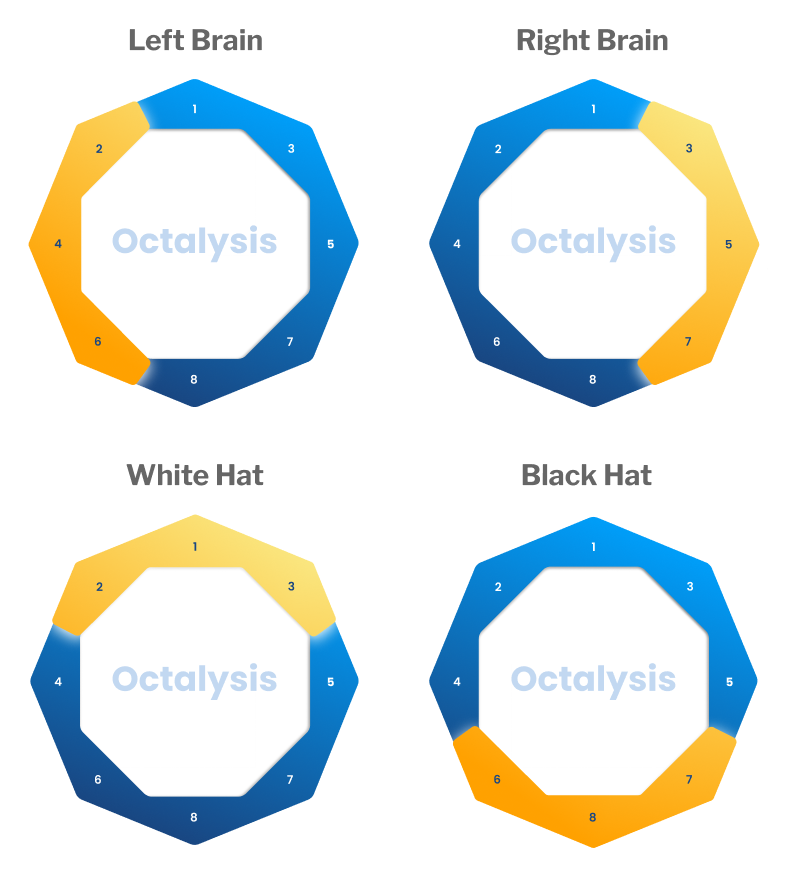
Left Brain (Extrinsic Tendency) vs. Right Brain (Intrinsic Tendency) Drives
I will repeat multiple times in this book that, because everything you do is based on one or more of these 8 Core Drives, when there are none of these 8 Core Drives behind a Desired Action, there is zero motivation and no action takes place. In addition, each of these 8 Core Drives have different natures within them. Some make the user feel powerful, but do not create urgency, while others create urgency, obsession, and even addiction, but make the user feel bad. Some are more short-term extrinsically focused, while some are more long-term intrinsically focused. As a result, these 8 Core Drives are charted on an Octagon not simply for aesthetic purposes, but because the placement determines the nature of the motivation.
Interestingly, Left Brain Core Drives tend to rely on Extrinsic Motivation - you are motivated because you want to obtain something. whether it be a goal, a good, or anything you cannot obtain. On the other hand, Right Brain Core Drives are mostly associated with Intrinsic Motivations - you don't need a goal or reward to use your creativity, hangout with friends, or feel the suspense of unpredictability - the activity itself is rewarding on its own.
This is important, because many companies emphasize designing for Extrinsic Motivators, such as providing users a reward when they complete a task. However, many studies have shown that extrinsic motivation impairs intrinsic motivation. Why? Because once the companies stop offering the extrinsic motivator, user motivation will often plummet to a level much lower than when the extrinsic motivator was first introduced.
It is much better for companies to design experiences that motivate the Right Brain Core Drives, making something in of itself fun and rewarding so users can continuously enjoy and engage in the activity. Motivation is often better when it sticks.
White Hat vs Black Hat Gamification
Another factor to note within the Octalysis Framework is that the top Core Drives in the octagon are considered very positive motivations, while the bottom Core Drives are considered to be more negative. I call techniques that heavily use the top Core Drives "White Hat Gamification," while techniques that utilize the bottom Core Drives are called "Black Hat Gamification."
If something is engaging because it lets you express your creativity, makes you feel successful through skill mastery, and gives you a higher sense of meaning, it makes you feel very good and powerful. On the other hand, if you are always doing something because you don't know what will happen next, you are constantly in fear of losing something, or because you're struggling to attain things you can't have, the experience will often leave a bad taste in your mouth- even if you are consistently motivated to take these actions.
It's important to note that just because something is called Black Hat doesn't necessarily mean it is bad. These are just motivators and they can also be used for productive and healthy results. Many people voluntarily submit themselves to Black Hat Gamification in order to go to the gym more often, eat healthier, or avoid hitting the snooze button on their alarm clock every morning.
The Hidden Ninth Core Drive: Sensation
Beyond the 8 Core Drives that will be explored in depth within this book, there is in fact a hidden ninth Core Drive called "Sensation," which is the physical pleasure one obtains from taking an action. People do drugs, get massages, or have sex (hopefully along with many other Core Drives) because of the sensation Core Drive. If you choose one food over another, it is often merely because one tastes better than the other, which is primarily sensation. They key differentiation here compared to other Core Drives is that sensation deals with physical feelings that bring pleasure to our touch, hearing, sight, smell, and even taste. The other Core Drives bring pleasure to us through psychological means the meaning and context behind what we see, hear, or taste.
How to Apply Level I Octalysis to Actual Systems
Facebook is very strong in many of the 8 Core Drives, but rather weak on Core Drive 1: Epic Meaning & Calling - there is generally no higher purpose on using Facebook unless you are one of the few who are actively contributing to a cause on Facebook.
It is also weak on Core Drive 6: Scarcity & Impatience, as these days there are very few things that users want to do on Facebook but are barred from doing it.
Facebook mostly focuses on Right Brain Core Drives, which focus on Intrinsic Motivation. It also trends more into the Black Hat zone, which means that it is more prone to drive obsessive behavior that encourages users to return on a daily basis.
Among the Left Brain Core Drives, we see that people are extrin sically motivated on Facebook, not so much to feel accomplished or gain exclusivity, but because of Core Drive 4: Ownership & Possession - to collect, customize, and improve what is theirs.
Like Facebook, Farmville and Candy Crush also lack Core Drive 1: Epic Meaning & Calling within, but Farmville also lacks Core Drive 7: Unpredictability & Curiosity - there are not that many surprises in the game. You go back on Farmville simply to harvest the crops that you planted a few hours earlier. Candy Crush is a little more balanced, but a little skewed towards the Right Brain Core Drives.
Twitter is also fairly well balanced but skews more towards Right Brain Core Drives. In contrast, LinkedIn is heavily focused on the Left Brain Core Drives, with a White Hat emphasis. This makes sense, because LinkedIn is all about your career, your life, your accomplishment. Those are very extrinsic goals, and as a result, everyone feels like they need to have a LinkedIn Account. However, because it lacks Right Brain (intrinsic tendency) Core Drives, there's not a lot of enjoyable activities on LinkedIn. And this has been the challenge that they have been faced with for many years. Users create their profiles, and then there is nothing left to do on LinkedIn. The account just sits there.
In the past couple of years, LinkedIn has been working very hard to increase engagement on the site, especially on Core Drive 5: Social Influence & Relatedness through Game Techniques such as Social Prods and Social Treasures - we will talk about how LinkedIn uses these Game Techniques in Chapter 9. However, through the Octalysis Framework we can see that LinkedIn could benefit massively if they put more effort into Core Drive 3: Empowerment of Creativity & Feedback, as well as Core Drive 7: Unpredictability & Curiosity.
Quick Intro to Level II Octalysis and Beyond
Once one has achieved mastery in Level I Octalysis, they can then apply it to Level II Octalysis, where we try to optimize experiences throughout all four phases of the player/user journey. These phases are: Discovery (why people would even want to try out the experience), Onboarding (where users learn the rules and tools to play the game), Scaffolding (the regular journey of repeated actions towards a goal) and Endgame (how do you retain your veterans).
Level II Octalysis: Factoring in the 4 Phases of a Player's Journey
Most people treat their product as one experience, which seems reasonable. But in terms of motivation, I believe this is a mistake because the reason you are using a product on Day 1 is often very different from that of Day 100. Since everything you do is because of one of these 8 Core Drives (besides the 9th hidden Core Drive-Sensation), if at any phase none of the 8 Core Drives are present, there is no reason for the user to move on to the next phase, and the user simply drops out.

During Onboarding, they might be motivated by Core Drive 2: Development & Accomplishment - feeling smart and competent during the early stages. During the Scaffodling Phase, they might be motivated because of the social dynamic (Core Drive 5) as well as trying to go after the goal they could not reach yet (Core Drive 6: Scarcity & Impatience). In the Endgame, they might continue to be engaged because they don't want to lose their status and achievements (Core Drive 8: Loss & Avoidance).
How you design for all four Experience Phases through the 8 Core Drives will strongly demonstrate your ability as an Octalysis Gamification Designer. Of course, never forget to design for the proper nature of the Core Drives, understanding when you want to have more Black Hat, when to have more White Hat, and when to use Extrinsic/Intrinsic motivators.
Once you have mastered Level II Octalysis, you can then push on to Level III and factor in the different player types. This will allow you to see how different types of people are motivated at different stages of the experience.

It is incredibly difficult to design something that pleases everyone. But with this framework, you can start to identify where the weaknesses are within your system and work on improving for motivation at various points. Once you become familiar with Level III Octalysis, you can almost feel how motivation moves within your system and recognize where motivation is lacking or whether there is too much Black Hat or Extrinsic Motivation in the system.
While there are five levels of Octalysis in total, Level I is often sufficient for the majority of companies seeking to understand why their products are not engaging their users. Higher-level Octalysis processes are useful for organizations that are truly committed to making sure that they push their metrics in the right direction and improve the longevity of a gamified system. Many games are only popular for three to eight months, but ones that have impeccable Endgame design can last over decades or even centuries.
Chapter 4: Putting Gamification in its Place
Product Gamification
Product Gamification is about making a product, online or offline, more engaging, fun, and inspirational through game design. Most companies struggle to create products that customers fall in love with, continue using, and passionately share with their friends. Some of these products have great "functional" purposes, but don't focus on the motivation and Core Drives of their users.
In a previous era, consumers didn't have adequate information and were accustomed to slow gratification. Along with immense barriers for starting new companies, it was not as detrimental for a company to simply assume that customers would use their products - provided that they were marketed correctly. However, people today are spoiled with instant gratification through the Internet, with immersive empowerment and real-time feedback through games, and the constant connection to their social network. Your users, customers, and employees are becoming less tolerant of badly designed products that do not take into account their motivations, especially when they have a variety of competitive alternatives they can choose from.
Many corporations and startups excitedly tell me, "Our product is great! Users can do this; users can do that; and they can even do these things!" And my response to them has been, "Yes, you are telling me all the things your users can do. But you have not explained to me why the user would do it."
That's the problem with a majority of company products great technology and functionalities, but no traction. People don't have a reason to go out of their way to use the product. Sometimes, a startup founder tells me, "Hey, Yu-kai, there's no reason why people wouldn't use our product. We save them money, we save them time, and we make their lives better." On lucky days, customers themselves would even say, "Yeah, there's no reason why I wouldn't use your product. It saves me money, it saves me time, and it makes my life better. I'll definitely sign-up sometime tomorrow."
For those who have run startups or launched products before, you know the crucial part of the entire phrase is the ending. When people say they will do it "tomorrow," more often than not it means "never." This is because at this point they are motivated by Core Drive 8: Loss & Avoidance, and specifically by something I call Status Quo Sloth (Game Technique #85) - they are avoiding a change in their habits and behavior.
Remember how we talked about how Gamification is actually Human-Focused Design learned from decades, even centuries of game design experience? When you are launching a new product, its motivational standing is very similar to a game. No one has to play a game. You have to do your taxes; you have to go to work; and you really should go to the gym. But you never have to play a game, and let's be honest, oftentimes you shouldn't.
Because games have invested an amazing amount of creativity, innovation, and resources into figuring out how to get people to want to spend more time on them, there are definitely many great lessons you can learn from games for your own products. The key here is to make a product so exciting that customers become obsessed with using your product and are compelled to share how exciting their experiences were to their friends.
Workplace Gamification
Workplace Gamification is the craft of creating environments and systems that inspire and motivate employees towards their work. More often than not, employees show up to work every day just so they can earn a paycheck (Core Drive 4: Ownership & Possession) and to not lose their jobs (Core Drive 8: Loss & Avoidance). As a result, employees only work hard enough to earn their paychecks and to not lose their jobs (if you recall, Core Drives 4 and 8 are great examples of Left Brain, Extrinsic and Black Hat Motivation).
In fact, Gallup's 142-country study shows that only 13% of employees are categorized as "engaged" with their work". In comparison, 24% of the workforce is categorized as "Actively Disengaged," which means they are so unhappy with their work that they minimize their productivity, spread negativity, and even sabotage productive efforts that require them to do more work to keep their jobs.
That is something pretty scary to think about. It means that, chances are, a quarter of your company is poisonous! How can any organism be competitive at anything if 24% of its body is composed of cancer cells?
Contrary to popular self-denial, it is actually not the employees fault they are disengaged. Companies like Zappos and Google (especially in the old days) are known to get their employees motivated, driven, and excited about their work on a daily basis. I firmly believe that everyone has the capacity and the longing to become motivated and driven for something that is worth their cause. It is bad environmental and cultural design that turns good employees into toxic cells.
Of course, you don't need a Gallup study to know how disengaged employees are at work. Just think about how often people close to you complain about their work or their bosses. Think about the movie Office Space, the quintessential comedy about life in a typical bland, rigid, and oppressive company in America". The movie was such a great hit and now a cult classic because people can actually relate to the frustration and disengagement of the characters in the movie (a good example of the "relatedness" piece within Core Drive 5 at work).
Why does that matter? Because research has shown that on average, the companies with disengaged and unmotivated employees only obtain 50% of profits and only 40% of revenue growth when compared to companies with engaged and motivated employees's. If I told you that you could double your profits and improve your revenue growth by 250% without opening new markets and without introducing new breakthrough technologies but by simply making your workplace more engaging and motivating, would you do it? Most people would say yes. But from my own personal experience, there will still be people who say no, simply because, "I don't want my employees playing games. It's a distraction!"
Workplace Gamification is critical for today's economy and the future of creative innovation. The Gen-Ys entering the workforce (and they are thirty now) are used to being in environments that provide them Epic Meaning, Relatedness, Autonomy, and more. This will only get worse as the even-younger generation enters the workforce, so it is wise for companies to start setting up the correct motivations systems as early as possible to avoid the devastation of having a surplus in labor but a shortage in talent.
Marketing Gamification
Marketing Gamification is the art of creating holistic marketing campaigns that engage users in fun and unique experience designed for a product, service, platform, or brand. Not too long ago, people clicked on online ads because, more often than not, they couldn't tell the difference between ads and content. But nowadays, users are becoming more sophisticated in filtering out unwanted promotions, decreasing the effectiveness of many advertisement campaigns (thanks in large part to ad blocker apps too).
Then you have TV commercials, where everyone simply tunes them out, switches the channel away, or just fast-forwards if they have a TiVo. As for other traditional methods like ads on billboards or newspapers...don't even get me started.
In the past decade, Search Engine Marketing (SEM) and Search Engine Optimization (SEO) have proven to be fairly effective techniques for gaining exposure and improving sales. In fact, a search engine is just a large leaderboard, and the industry of Search Engine Optimization is simply the game to climb to the top of that leaderboard. This works because 1) you can target the right people who are searching for your exact solution, and 2) you can target them at the right time they are searching.
However, SEO and SEM still lack the trust component in online marketing. If a website you trust and have followed for two years sells something you need, you are likely not going to go searching for a random site on a search engine to purchase from.
Enter Social Media Marketing. Through platforms like blogs, Facebook, Twitter, and Youtube, brands are able to build relationships with potential customers, create unique value, and establish trust that leads to future engagement. Unfortunately, social media platforms are just the delivery channels for engaging content; in and of themselves, they do not motivate or successfully engage with users.
This is where Gamification comes in. Marketing Gamification specifically utilizes game elements and strategies throughout a player's journey by first focusing on why a user would engage with you in the first place. Marketing shouldn't just be one action done from the marketer and one response back from the customer, but should be an entire ecosystem where both the marketer and customer are able to experience fun and feel continuously engaged through a variety of interactions.
Marketing Gamification utilizes the platforms and vehicles described above as well as others: SEO, Social Media, Blogging. Email Marketing, online/offline competitions, viral vehicle strategies, and reward schedules to continuously engage users throughout an engaging and gamified experience.
Lifestyle Gamification
Lifestyle Gamification involves applying gamification principles and the 8 Core Drives into daily habits and activities, such as managing your to-do list, exercising more often, waking up on time, eating healthier, or learning a new language.
There are also many technological enablers that make Lifestyle Gamification more popular, including big buzzword trends such as Big Data, Wearable Tech, Quantified Self, and The Internet of Things". The interesting thing about all these trends is that it enables all your activity to be tracked allowing you the ability to manage your Feedback Mechanics and Triggers.
Games have historically been able to track every single action that a player makes. A game would automatically know that this particular player is on Level 3, she has picked up these 4 items, learned these 3 skills, talked to these 6 characters, but not those other 3 characters, and because of that, this door does not open for the player.
A game remembers everything you have done and customizes your experience based on that. In real-life, most of your "data" is not recorded, and so it is hard to craft a optimized lifestyle. The trend with wearable tech and quantified self finally allows us to track more of our own behavior on a daily basis. Of course, even companies that claim they wield the power of Big Data don't yet compare to the level of customization that gamers take for granted. Many still stick to generalized demographics and non-actionable reports, instead of creating a unique experience for each user in real-time
Lifestyle Gamification branches into a few sectors such as Career Gamification, Health Gamification, Productivity Gamification, and Education Gamification. It can be utilized to gamify big picture activities such as accomplishing your life goals, or very tactical activities such as using a dice to determine how you should reward yourself (which is derived from Core Drive 7: Unpredictability & Curiosity).
Chapter 5: The First Core Drive - Epic Meaning & Calling
Epic Meaning & Calling is the First Core Drive of Octalysis Gamification. This is the drive where people are motivated because they believe they are engaged in something bigger than themselves.
Games often trigger the Epic Meaning & Calling Core Drive. In many games, an intro narrative communicates that the world is about to be destroyed, and somehow, you as the player are the only one qualified to save the world. That immediately creates excitement and motivation towards the adventure.
What about real life? Do we ever encounter scenarios where we are driven by Epic Meaning & Calling?
- Have you ever wondered why people contribute to the non-profit website Wikipedia? What would make someone spend hours updating a site that doesn't pay her or even help her build her resume?
- Why are people so loyal to Apple products, to the extent that they know they want to buy the next product, even before they know what it is?
- Why are school rivalries so engaging, driving radical behav-tors such as pranks, streaking, violence, while also leading to profit for the schools?
- Can higher purpose also be designed into parenting styles beyond the usual reward and punishment system?
When it comes to Epic Meaning & Calling, it's not about what you want as an individual nor about what makes you feel good. Individuals participate in the system and take action not because it necessarily benefits them, but because they can then see themselves as heroes of a grander story. It's about playing your part for the greater good.
Game Techniques within Epic Meaning & Calling
| Number | Name | Explanation | Example |
|---|---|---|---|
| 10 | Narrative | A story or context that explains why the user’s actions matter. By framing an activity within a larger narrative, users feel part of something meaningful. | A fitness app might cast your workouts as “missions” to save a virtual world, giving each exercise a fun story context. This narrative makes each small action feel like it contributes to a bigger goal. |
| 23 | Beginner's Luck | Giving new users an exceptionally good outcome or bonus when they first start. It makes them feel specially chosen and hooked. | A new player randomly getting a very powerful weapon on their first day (as in a game scenario) makes them feel lucky and engaged. This boosts confidence and encourages continued play. |
| 24 | Free Lunch | Temporarily giving something for free (usually something normally paid) tied to a special occasion or theme. It creates a sense of privilege and goodwill. | A restaurant offering free meals on a holiday (e.g. free lunch for some patrons on International Women’s Day) makes those customers feel special and encourages loyalty. Such surprises delight users and reinforce the brand’s story. |
| 26 | Elitism | Letting users form or join prideful groups (teams, factions, in-groups) to foster competition and status. Members feel special belonging to a larger cause. | College sports team rivalries (like UCLA vs. USC) create elitism: students rally around their team’s identity, boosting engagement and actions (like attending games or buying gear). |
| 27 | Humanity Hero | Tying user actions to a charitable or world-bettering cause. It satisfies the drive to feel like a hero helping others. | TOM’s Shoes sends a pair to a child in need for every pair bought. Users then feel they’re contributing to a larger mission by their normal actions, motivating them to continue (and share) that behavior. |
Chapter 6: The Second Core Drive - Development & Accomplishment
Development & Accomplishment is the Second Core Drive of the Gamification Framework Octalysis. This is the Core Drive where people are driven by a sense of growth and a need to accomplish a targeted goal. It is what focuses us on a career path, generates our enthusiasm and commitment to learning a new skill, and ultimately motivates us by showing us how far we've come and how much we've grown.
Many people have memories of their kindergarten teachers giving them gold stars to emphasize good behavior. Even though these stickers don't become real prizes, children are often extremely intent on obtaining more stars and will focus on determining how best to gain them. That's a very straightforward demonstration on the effects of Development & Accomplishment and how easy it is to add them into an experience.
This is also the most common implementation of gamification we see in the market, as most of the PBLs points, badges, and leaderboards appeal heavily to this drive.
Development & Accomplishment in Games
Almost all games show you some type of progress towards the Win-States. A Win-State is often a scenario where the user has overcome some sort of challenge - that's the "win" in the Win-State. Games break down user challenges into stages to help the user feel like there is always progress.
Our brains have a natural desire to achieve goals and to experience growth in order to feel that real progress in life is being made. We need Win-States. Games can sustain long 40-hour or even 4000-hour player journeys because they use distinctive stages and boss-fights to recognize user accomplishment along the way.
To display that sense of accomplishment, some games show you points, others use levels, badges, stages, progress bars, better looking gear, victory animations... the list goes on. However, just because you see your progress through these elements does not necessarily mean you feel accomplished.
The key to Core Drive 2: Development & Accomplishment is to make sure users are proud of overcoming the challenges that are set out for them. Jane McGonigal, renowned game designer and Ph.D. in Performance Studies, defines games as "unnecessary obstacles that we volunteer to tackle."
McGonigal points out that challenges and limitations are what make a game fun. For example, if golf was just a game without any limitations, every player would just pick up the ball and put it into the hole to win. Everyone would score high, and every individual who has outgrown the "putting a round peg through a round hole" game will probably feel bored.
By adding unnecessary obstacles, such as requiring the use of a strange stick, certain distances, and landscape hazards, golf becomes fun because the player actually feels accomplished once such challenges are overcome. Gamification aims to integrate that feeling of Development & Accomplishment into everyday experiences within your product or service.
"I overpaid for my product. Take that, suckas!"
It's easy to see how eBay uses Core Drive 2: Development & Accomplishment to make the experience more fun and addictive for the Seller. But what about the Buyer? What makes a buyer want to continuously buy on eBay?
From the buyer's perspective, the genius thing about eBay is that when a purchase is made, you aren't just buying something online like you do on other eCommerce platforms. No, instead of feeling that you are just acquiring some items in exchange for your money, you feel like you've actually Won!
Sure, after some adrenaline-filled bidding at the end, you may have ended up paying ten percent more than you otherwise would have, but you at least achieved victory over those eleven other bastards who were bidding against you!
"Take that suckas! It's mine!"
Instead of just paying your way to success, which anyone could do easily, you worked hard and actually achieved a Win-State! You feel accomplished, and the value of that happiness far exceeds the extra money you end up paying for the item. On eBay, you are not paying to purchase; you are paying to play.
This is similar to games where people spend money in order to beat difficult levels that they can't overcome. To be exact, people aren't buying victories. If, immediately after people pay the game studio, a message pops up and says, "Congratulations! You have won!" very few people would feel excited. Anyone could just pay money and get something. What gamers are paying for, is the feeling of being awesome. They pay to get powerful weapons or boosters that allow them to defeat a bunch of enemy monsters quickly, ultimately achieving dominating victory.
Game Techniques within Development & Accomplishment
| Number | Name | Explanation | Example |
|---|---|---|---|
| 1 | Status Points | A numeric score or point system that tracks a user’s progress or status (often shown as points or levels) in a system. It signals achievement and growth over time. | Frequent flyer miles or Reddit karma – both count as “status points” showing how much a user has contributed or earned, motivating them to earn more |
| 2 | Achievement Symbols | Visual icons (badges, trophies, stars, etc.) awarded for achieving goals. They symbolize milestones or accomplishments, providing tangible recognition of progress. | Twitch’s streamer badges (e.g. for affiliates or partners) are achievement symbols that show a streamer’s status and motivate them to hit new milestones |
| 3 | Leaderboard | A ranked list displaying users’ scores or performance relative to others. By showing who’s at the top, leaderboards tap into users’ competitive drive. | Many fitness apps rank users by steps per day, so people strive to climb higher on the leaderboard. Leaderboards should be designed carefully (e.g. showing only nearby ranks) to keep most users feeling they have a chance to improve. |
| 4 | Progress Bar | A visual bar that fills to indicate how much of a task or goal is complete. It turns partial progress into a clear visual, driving users to close the gap to 100%. | LinkedIn’s profile completeness bar shows a percentage of how much of your profile is filled in;seeing, say, “35% complete” encourages you to add more information to “finish” the bar. |
| 92 | The Rockstar Effect | When you give users signals that they’re becoming “famous” — like growing follower counts or visible attention — which motivates them to keep posting, sharing, and building their audience. | Twitter’s one-way “Follow” system made getting followers feel like a real achievement. People competed to gain more followers, culminating in the famous Ashton Kutcher vs. CNN race to reach 1 million followers first. |
Chapter 7: The Third Core Drive - Empowerment of Creativity & Feedback
Many fun games are played for 2-8 months, but afterwards players move on to new games. However, it doesn't mean that gamifying your system would automatically result in the same situation due to two important reasons.
First, remember I mentioned earlier that there is generally no real purpose for playing a game; that is, most people never have to play a game. The instant a game is not fun, people will leave and play other games or go on Youtube/Facebook/email. As a result, after two to eight months, the game will often fail to engage people so they drop out. Hopefully the system that you are designing actually has a purpose to it, and so even if it becomes boring (which is probably the current state anyway), your users still have a reason to stay on.
The second reason is because most of these games have not been designed for continued motivation in the "Endgame", the fourth and final phase of a player's journey. If the experience is no longer engaging in the endgame, you simply move on to other games.
Many well-designed games, like Starcraft, have managed to engage the interest of players for more than a decade. Other games like Poker, Golf, Chess, Mahjong, have all stood the test of time and are still popular after centuries of use. Now there are many ways to design an engaging Endgame, but the reason why so many of these games stand the test of time is largely due to their utilization of Core Drive 3: Empowerment of Creativity & Feedback.
In a study published by Queen Mary University of London and University College London in 2013, researched compared the effects of different games on the brain. After six to eight weeks, the study revealed that students who played Starcraft roughly an hour a day improved their memory, visual search and informational filtering abilities, as well as other cognitive skills.
When a user can continuously tap into their creativity and derive an almost limitless number of possibilities, the game designer no longer needs to constantly create new content to make things engaging. The user's mind becomes the evergreen content that continuously absorbs their attention into the experience. That's the power of Core Drive 3: Empowerment of Creativity & Feedback in retaining users for the long haul.
Tic-Tac-Draw
The great thing is, to be at the top of the chess world, you don't need to play in one, specific "best" way. You can create your own style of play through meaningful choices that reflect your personality and style. As long as you invest the rigorous work, maintain the commitment, and have passion for the game, you will have a chance of becoming a great chess player.
This capacity to allow players to express their unbounded creativity, sec immediate feedback, and offer them meaningful choices to demonstrate different styles of play is what makes Core Drive 3: Empowerment of Creativity & Feedback so appealing to gamers, users, customers, and employees alike. When you design a great gamified system, you want to make sure that there isn't one standard way to win. Instead, provide users with enough meaningful choices that they can utilize drastically different ways to better express their creativity, while still achieving the Win-State.
The General's Carrot in Education
When you design for Core Drive 3: Empowerment of Creativity & Feedback, it is important to create a setup where the user is given a goal, as well as a variety of tools and methodologies to strategize towards reaching that goal. Often your users are not motivated because they don't understand the purpose of the activity, do not clearly identify the goal of the activity, and/or lack meaningful tools to create expressive strategies to reach the goal.
When the child is memorizing the periodic table, they do not see the purpose of doing so. It is only to pass a test, get a good grade, and please their parents. As a result, the child studies hard enough to pass the test, and forgets most of the subject matter thereafter. But in these card games, the child is learning the information in order to come up with awesome strategies, beat their friends, and feel accomplished. Also, since they personally own many of these cards, they are anxious to study them, understand their strengths and weaknesses, and research what other cards are out there (an effect within Core Drive 4: Ownership & Possession).
If the means to that end is to memorize thousands and thousands of terms and stats, it becomes worth it, even fun. As designers, it is important to recognize that they understand the goal (beating their friends), build ownership and familiarity with their tools, and use their unique strategies and experience towards that.
Empowerment and Creativity in the Corporate Space
Core Drive 3: Empowerment of Creativity & Feedback also applies to the workplace and employee motivation.
An example of a company who attempted to embed Empowerment of Creativity & Feedback into their workplace was Google. They implemented a program called 20% Time - where one day in the week, employees can work on any project they would like, as long as the Intellectual Property belonged to Google.
Many employees who wanted to become an entrepreneur mostly did so because they had great ideas and wanted to see it become reality. But most of them still don't enjoy the risk and the hassle of starting a company. With 20% Time, employees no longer felt a need to start their own companies because they could simply build their ideas in the safe and comfortable haven of Google.
As a result, some of the most successful product lines such as Gmail were spawned from an emphasis on this Core Drive of Creativity. Unfortunately, 20% Time was shut down as Google became larger and wanted to "put more wood behind fewer arrows."
Game Techniques within Empowerment of Creativity & Feedback
| Number | Name | Explanation | Example |
|---|---|---|---|
| 11 | Plant Picker / Meaningful Choices | Give users truly meaningful choices — options that reflect different styles, strategies, or preferences, where none is obviously “best.” This fuels creativity, ownership, and replayability because users shape their own path. | In Plants vs. Zombies, players choose which plants to bring into each level. There are many viable strategies (economy-first, heavy defense, traps, splash damage), so players experiment and play differently — and feel proud of their strategy. |
| 19 | Milestone Unlock | Introducing new capabilities or content when the user reaches certain levels. Users see a gate or reward become available as they progress. | Pokémon Go lets you catch stronger Pokémon or use better items once your player level increases (unlocking new features at milestones). This keeps users motivated to reach the next level to get the next “unlock.” |
| 31 | Boosters | Boosters give users a limited-time or limited-condition advantage. Because the power-up is temporary, players feel urgency and excitement while it lasts, motivating them to act quickly and stay engaged. | In Super Mario, grabbing a Star makes you invincible for a few seconds, so players rush forward to maximize the effect. In Candy Crush, boosters like the Color Bomb help overcome hard levels and can be earned or purchased. |
| 89 | Poison Picker / Choice Perception | Give users the feeling of choice— even if all options ultimately lead to the same outcome. People are happier and more cooperative when they believe they chose the path themselves, even if the choices are limited or slightly “poisoned.” | When onboarding, instead of “Create your account,” apps show:“Sign up with Google or Sign up with Email.” Either way, the user signs up — but they feel empowered because they decided how. |
Chapter 8: The Fourth Core Drive - Ownership & Possession
Ownership & Possession is the fourth Core Drive in Octalysis Gamification. It represents the motivation that is driven by our feelings of owning something, and consequently the desire to improve, protect, and obtain more of it.
This Core Drive involves many elements such as virtual goods and virtual currencies, but it is also the primary drive that compels us to collect stamps or accumulate wealth. On a more abstract level, Core Drive 4 is connected to our investment of time or resources into customizing something to our own liking. This can also be found in a system that constantly learns about your preferences in order to mold an experience that uniquely fits you.
Ownership & Possession is positioned to the far left of the Octalysis Framework, and therefore represents the Core Drive that exhibits the strongest influence on the Left Brain (again, this is not sci-entifically geographical but more symbolic) relating to analytical thinking. Here, decisions are mostly based on logic and analysis, reinforced by the desire for possession as the primary motivating factor.
For example, in Farmville, you are constantly striving to increase the value of your assets by developing your land, establishing higher crop yields, and improving the quantity and quality of your livestock. You can further develop your property's infrastructure and dwellings- establishing that country manor on your dream estate.
Because of this, you find yourself constantly investing more time and energy in expanding your farm. Accumulating more cows, plants, and fruits as well as purchasing stables to house your horses or grooming services to make them look "prettier."
How Stoned Can You Be
What if I told you that a large piece of stone somewhere in the world is in my possession, and I will trade it to you for a million dollars. However, you won't be able to move it and it will have to be left in its original place, just like the owner before me did. What would you think of the arrangement?
However, that's what we actually see in modern, developed societies regularly. If a businessman told you that he owns a famous building or monument in Chicago, and will pass the ownership rights to you if you paid him $100 million, suddenly it's not as crazy - beyond the fact that you may not have the money handy.
You may not have even seen the property - it's not strictly required for the purchase, especially if it is already well known - nor will you be able to move it anywhere, but now it is considered a legitimate business transaction that anyone will take seriously. Of course, in order to make sure you can prove the transfer of ownership, you in this case would prefer to have this agreement on paper instead of memorized orally. Such is the strange nature of ownership.
The First Virtual Pet Game
Over the years, there were 76 million Tamagotchi's sold worldwide. It became one of the earliest precursors of popular social games where the key objective is to care for an animal, a property, or a business.
It looks like this ingrained sense of Ownership & Possession, along with some added benefits of novelty (Core Drive 7: Unpredictability & Curiosity), made products like Pet Rocks, Tamagotchi, and later on Facebook games like Farmville or Pet Society such big successes worldwide.
The Endownment Effect
James Heyman, Yesim Orhun, and Dan Ariely further showed that the Endowment Effect is also realized when we simply imagine ourselves owning something. They found within auction sites, the longer people remained the top bidder (having imagined themselves as the official owner for longer), the more aggressively they would bid when someone offered a counter bid. The envisioned ownership actually motivates people to fight for their divine rights to that item they don't yet own.
This is why advertisers often try to get consumers to imagine themselves owning the promoted products by asking consumers to think about what they would do with those products. Also, trial promotions and "money-back guarantees" work the same way by letting consumers own the product first without any friction. Since we now know that the value of something becomes much greater after it is in our possession, consumers often feel reluctant to return that product and get their money back afterwards.
Game Techniques within Ownership & Possession
| Number | Name | Explanation | Example |
|---|---|---|---|
| 16 | Collection Sets | Goals involving gathering related items or sets. Users strive to complete an entire collection. | “Gotta catch ’em all!” – in Pokémon Go you try to catch every type of Pokémon (a collection set). This taps into completion drive, as people enjoy filling gaps in collections. |
| 42 | Monitor Attachment | Monitor Attachment happens when users frequently check on something — stats, progress, growth, or status — and gradually feel ownership over it. The more they monitor it, the more invested they become and the more they want it to improve. | Google Analytics turns new bloggers into daily obsessors: watching pageviews rise from 3 to 4 makes them feel connected to their blog. This repeated monitoring creates ownership and motivates them to keep improving their content. |
| 43 | Build From Scratch | Having users create or assemble something themselves. This hands-on process makes them invest effort and feel ownership. | Like IKEA furniture, if a user “builds” part of their own profile or product by choosing from parts or designing it, they feel more attached. Giving users tools to construct something increases their sense of possession. |
| 75 | Exchangeable Points | These are points users can spend, redeem, or trade for valuable rewards. Unlike status points (which only track progress), exchangeable points act like a currency — which makes them motivating but also requires careful economic balance so the rewards feel fair and scarce. | In Starbucks Rewards, users collect stars and redeem them for free drinks or food. Because stars have real value, Starbucks must constantly balance how fast users earn stars versus how much rewards cost. |
| 83 | Alfred Effect | The Alfred Effect occurs when a product feels so personalized — so tailored to your habits, preferences, and history — that switching to anything else feels unthinkable. The system “knows you,” remembers your choices, and adapts itself accordingly, creating strong loyalty. | Waze learns your routines: at 6 PM it suggests going home, at 8 PM on Wednesdays it might suggest your gym. Even if another navigation app has better features, Waze feels like it understands you personally — and that’s the Alfred Effect. |
Chapter 9: The Fifth Core Drive - Social Influence & Relatedness
Social Influence and Relatedness is the fifth core drive within Octalysis Gamification and involves activities inspired by what other people think, do, or say. This Core Drive is the engine behind many themes such as mentorship, competition, envy, group quests, social treasure, and companionship.
Core Drive 5: Social Influence & Relatedness is a Right Brain Core Drive that bases its success off our desires to connect and compare with one another. With the proliferation of new social media tools and platforms, more and more companies are working on optimizing Core Drive 5 during the Discovery and Onboarding Process.
Almost every consumer app these days urges you to "Invite Your Friends" upon joining their service. However, just because the social platform is there to spread a message does not necessarily mean there is engaging, share-worthy content. There are many pitfalls as Social Influence & Relatedness is a double-edged sword and needs to be wielded carefully.
When utilized properly, it can serve as one of the strongest and long-lasting motivations for people to become connected and en-gaged to your experience.
The Mentor that Stole My Life
This is an interesting thought because I didn't really care about the game at that point. But when we see someone else effortlessly complete something that we struggle hard against, our brains automatically develop a feeling of envy. How people deal with that envy may be different - some become inspired with "I want to be like that one day!", whereas others enter into denial, "Well, I can never do that, but the whole thing is stupid anyway." This game had cleverly designed for the former.
When you design an environment where people are prone to be envious of others, you want to make sure there is a realistic path for them to follow to in achieving what they are envious about. Otherwise you will simply generate user denial and disengagement. We will explore this theme more in Chapter Ten on Core Drive 6: Scarcity & Impatience.
After following my mentor for a couple hours to conquer a few dungeons, another thought began to hit me. "Man...this guy is a high level player. He should be fighting in the high level dungeons. He gains nothing here and is just wasting his time. He is investing in me! Of course I can't quit now. I would be the biggest disappointment ever!"
How many times have you tried to withdraw from a volunteer group, team, church, or even a relationship, but had an extremely hard time because you didn't want to upset other people?
We derive some of our most joyful experiences when we are with friends and family, and experience stress and anxiety when these relationships aren't going well. We are innate social animals, and naturally endowed with a sense of empathy. We are influenced by what other people feel and think about us.
Understanding the dynamics of Social Influence & Relatedness is something every good Octalysis Gamifier should become familiar with.
Social Influence vs. Epic Meaning within a Team
Generally, the leader's goal is to motivate each teammate to feel driven by Epic Meaning & Calling. The leader is successful if everyone becomes passionate about the higher meaning of the project or company mission and is willing to make some personal sacrifices to successfully push their shared agenda forward.
On the other hand, if the leader loses that Epic Meaning & Calling and becomes solely motivated by Social Influence & Relatedness, the team will start to crumble from within. Now the leader is no longer motivated by the higher vision of the group, but only working to please their teammates. They have now become an insecure leader, and an insecure leader is an ineffective leader.
When you are leading a team, never lose sight of that Epic Meaning & Calling. Of course, you always want to pay close attention to the feelings and motivations of each teammate, as well as the Core Drives that motivate them. However, if making them feel good becomes the priority you think about day in and day out, then you may end up with a happy group that goes nowhere and fails in the end. The opposite is true too: neglect your teams' well-being and you'll have a sad group that's burnt out and struggling to fulfill the mission.
Corporate Competition as an Oxymoron
When competition works:
- In situations where players aim to achieve mastery of the task
- In gain-oriented scenarios and mindsets where players focus on becoming the winner
- When contestants reach their Individual Zone of Optimal Functioning (IZOF), which means their anxiety and arousal level reaches a heightened degree of focus151.
- When players care about the welfare of the team
- When players are primed to overcome obstacles, and not what they will do after reaching the goal
- With situational anger to confrontations
- When there is an even matchup and players feel that they actually have a chance
- When players care about the competitors (competing against your friends instead of every stranger in the world)
Competition does not work:
- In learning-focused environments
- In prevention-oriented situations and attitudes where players focus on not being the loser
- When teams are too harmonious and competition becomes awkward
- When creativity is required
- When the competition is regarded as skewed and there is little chance to win
Though game mechanics and elements can be used to motivate employees and promote the behaviors that the company wants to see, each competitive initiative should be well thought out and designed with considerable finesse. Arbitrary use of game elements modeled on competition may be useful for short-term sales campaigns, but may be disruptive and anti-productive in the long term.
Instead of taking the zero-sum approach to motivate the best performers, we should consider strategies which bring individual strengths together and produce effective cooperation. In the long run, this formula will generally outperform the individualistic paradigm of workplace motivation.
Cooperative play can help preserve and improve a positive corporate culture, as well as support and encourage the development of talent and skills. At the same time, it increases competitive strength where it really matters - outside in the marketplace.
Game Techniques within Social Influence & Relatedness
| Number | Name | Explanation | Example |
|---|---|---|---|
| 22 | Group Quests | Tasks that require a group of users to participate before anyone can get the reward. It leverages social and viral motivation, since users must team up. | In World of Warcraft, some quests need 40 players to succeed. Or the Groupon “group buy” where a discount activates only when enough people join – users recruit friends to complete the group quest. |
| 55 | Water Coolers | Forums or social spaces for users to chat and bond. This recreates an office “water cooler” environment online. | Adding a discussion forum or chat room on a platform gives users a place to share gossip, tips, or support. These informal interactions build community norms and keep people connected. |
| 57 | Brag Button | Buttons or prompts that make it easy to share achievements publicly. They are explicit “share” actions after a win. | After beating a level, a game pops up a “Share your score” button for Facebook or Twitter. This lets users broadcast their accomplishments to friends, fueling pride and attracting new users. |
| 58 | Conformity Anchor | Showing the user how others are doing (social proof) to nudge them into following the norm. It leverages peer comparison. | Utility apps displaying “Your neighbors saved 20% on energy; you used $10 more” uses a conformity anchor. People adjust to match social norms, so visualizing community behavior influences individual actions. |
| 61 | Mentorship | Mentorship pairs an experienced user with a newcomer to provide guidance, support, and encouragement. This creates a strong sense of belonging for newbies and a sense of pride, purpose, and status for veterans. It improves onboarding, keeps advanced users engaged, and builds a healthier, more connected community. | An e-commerce site lets experienced sellers toggle “I’m available to mentor.” New sellers can ask them quick “how do I…?” questions in chat. Veterans gain status perks or small rewards, newbies get friendly help, and the platform saves support costs. |
| 62 | Social Prods | Social Prods are super-lightweight social actions that require almost no effort—like a “Like,” “Poke,” or quick endorsement. They let users interact without needing to think, write, or commit. They create tiny social nudges that keep people engaged and often trigger reciprocal actions. | In a wellness app, users can send each other a quick “Boost” with one tap. It doesn’t say anything specific — it just notifies the other person: “Ana sent you a Boost ✨.” Ana doesn’t need to write a message, and the receiver usually taps “Boost back,” creating effortless social interaction that keeps both users feeling connected. |
| 63 | Social Treasures | Valuable items or rewards that can only be obtained from friends or other players. This encourages social sharing. | In Candy Crush, you can only get extra lives when friends send them to you (you can’t buy them directly). Asking for these rare items draws friends in and promotes viral growth. |
Chapter 10: The Sixth Core Drive: Scarcity & Impatience
Scarcity and Impatience is the sixth core drive of the Octalysis Framework. It is the drive that motivates us simply because we are either unable to have something immediately, or because there is great difficulty in obtaining it.
The Leftovers aren't all that's Left Over
Most of us would like to believe that we make purchasing decisions based on the price and quality of a good. A purchase is seen as a very rational exchange of money for an item that we desire. If the price were greater than the "utility," or happiness that we derive from the valuable, then we don't make the purchase.
However, psychological studies have shown again and again that this is only partially true. We buy things not because of their actual value, but rather based on their perceived value, which means many times our purchases aren't very rational.
In 1975, researchers Worchel, Lee, and Adewole conducted an experiment to test the desirability of cookies in different cookie jars. The experiment featured two cookie jars, one with ten cookies in it, and the other with only two. Though the cookies were exactly the same, the experiment revealed that people valued the cookies more when only two were available in the jar. They valued those cookies more, mainly for two reasons: 1) Social Proof - everyone else seems to prefer those cookies for some reason, and 2) Scarcity- people felt that the cookies were running out.
In a second experiment conducted by the team, subjects watched as the number of cookies in the "ten-cookie" jar were reduced to two cookies, while the other group saw the "two-cookie" jar get filled up to ten cookies. In this case, people started to value the former more and devalue the latter. When people saw that there was now an abundance in the first jar which earlier had only two cookies, they valued these even less than those from the "ten-cookie" jar of the first experiment where there were ten cookies to begin with.
Here we see that, when there is a perceived abundance, motiva-tion starts to dwindle. The odd thing is, our perception is often influenced by relative changes instead of absolute values. People with $10 million would perceive their wealth differently (and feel differently) if they only had $1 million the year before, versus if they had $1 billion the year before.
Persuasively Inconvenient
As illustrated in the examples above, our brains intuitively seek things that are scarce, unavailable, or fading in availability.
Oren Klaff is a professional sales pitcher and fundraiser who claims to close deals through a systematic method which he calls neuroe conomics, a craft that combines both neuroscience and economics. By digging deep into our psychology and appealing to what he calls the "croc" brain, the method utilizes various Core Drives such as Social Influence & Relatedness, Scarcity & Impatience, as well as the upcoming Core Drive 7: Unpredictability & Curiosity and Core Drive 8: Loss & Avoidance.
- We chase that which moves away from us
- We want what we cannot have
- We only place value on things that are difficult to obtain
My father is a diplomat for Taiwan, and sometimes he would talk to a colleague who was deployed to a former communist country in Eastern Europe. I once heard the colleague say, "If you see a line on the street, don't even waste time finding out what they are in line for. Just get in line. It must be something essential like soap or toilet paper. It doesn't matter if you have money. If there is no toilet paper in the region, your money is useless." Here, the sheer inconvenience driven by scarcity and social proof can compel a comparably wealthy person to stand in line for hours.
In Pitch Anything, Oren Klaff also brings up another example where BMW released a special-edition M3 that required the buyer to sign a contract promising to keep it clean and take care of the special paint. Without this promise in writing, they won't even allow you to purchase the car! In this case, BMW is inflating its value so that the buyer will believe it is a special and exclusive privilege to drive the car. Maybe that's why the hard-to-get strategy in dating culture is so prevalent. Through Core Drive 6: Scarcity & Impatience, you can keep your prospective partner on their toes.
Curves are better than Cups in Economics
When I was studying Economics at UCLA, the one fundamental lesson that my professors regularly talked about was the Supply and Demand curve. It basically explains that if the price of an item drops, the demand will increase. If the item becomes completely free, the curve will indicate the maximum number of buyers that will acquire it.
However, if you study behavioral psychology, gamification, and/or Human-Focused Design, you will find that there is another side to the story. As it turns out, Scarcity is another driving force of consumer behavior. In economic theory, scarcity is well understood, but only in the sense of objective limits matched against the consumer's utility derived from a purchase.
Scarcity works because people perceive something to be more valuable if it is more expensive or less attainable. Because people don't have "perfect information," they generally do not fully know their utility for a certain good. Therefore, they rely on cues - such as how expensive or limited something is to determine its value. If everyone wants it, it must be good! This goes hand-in-hand with the last chapter on Core Drive 5: Social Influence & Relatedness.
"I Don't Feel Good When My Pocket Is Too Full After A Purchase"
Since you don't do anything with jewelry other than show it off to others (or yourself), the value is usually based on perception as until someone told you opposed to functionality. You may quickly dismiss the value of an ugly and cracked pottery piece on the shelf, that it was made 1,200 years ago for a historically significant event. The pottery itself did not functionally or aesthetically become more valuable, but its perceived value immediately went up due to the principles of scarcity.
Up to this point, you may have observed that the high-price principle within Core Drive 6 works powerfully for luxury items that serve little functional purpose such as jewelry, or expensive services that provide essential expertise. Surprisingly, it also works with everyday functional items.
Daniel Kahneman, author of Thinking: Fast and Slow, refers to our brain's neocortex as our System 2, which broadly controls our conscious thinking. Since the processing capabilities of our brain's neocortex are limited, we regularly rely on mental shortcuts, known as heuristics, without noticing them. In this situation, the mental shortcut was that "expensive equals quality" when it may not have necessarily been the case.
Another mental shortcut can be, "The Expert said it with confidence -I will assume it to be true without looking too deeply into it." Sometimes people let pass some obvious blunders and oversights simply because the authoritative expert or scientist said so. They let their "System 2" become lazy and simply become motivated by Core Drive 5: Social Influence & Relatedness.
Game Techniques within Scarcity & Impatience
| Number | Name | Explanation | Example |
|---|---|---|---|
| 21 | Appointment Dynamics | A recurring timing mechanism that creates scheduled events or deadlines. Users must return or act at specific times to get rewards. | “Happy Hour” deals at lunch are an Appointment Dynamic: customers plan to show up at a designated time to enjoy special prices. In apps, this appears as limited-time events or notifications to come back (e.g. a daily bonus at midnight). |
| 37 | Evolved UI | Gradually unlocking interface complexity over time. Instead of overwhelming beginners with all features, new options appear as users progress. | A beginner only sees a few buttons at first; as they master tasks, more buttons and tools appear. (This mimics many games like World of Warcraft, where top players see many on-screen elements, but newbies start simple.) This avoids decision paralysis early on. |
| 44 | Dangling | Dangling is when you repeatedly show users an attractive reward they can’t have yet, creating desire through scarcity. The reward must feel difficult but still realistically achievable — otherwise users give up. The constant tease builds motivation until the user finally takes action to obtain it. | In Farmville, the game repeatedly shows you an appealing mansion you want but can’t afford. After seeing it many times, you start wanting it — even though it takes 20 hours of farming to get it unless you pay $5. |
| 66 | Torture Breaks | Unexpected enforced pauses that interrupt progress. Unlike scheduled breaks, these are sudden “you must wait” stops. | Mobile games often force you to stop playing after a short session (e.g. telling you to wait 5 hours for lives to replenish). This frustrates at the moment but keeps the game on the user’s mind, driving them to return (or pay to skip the break). |
| 68 | Magnetic Caps | Temporarily lifting restrictions (giving abundance), then reinstating scarcity later. This makes features feel valuable. | Letting a new user play unlimited levels initially, then capping them after a while creates a “magnetic” craving to keep playing. The temporary abundance hooks users, and when limits return, they strive to regain the unlocked status. In a store “Limit 12 per person” and people will end up buying more. |
| 69 | Anchored Juxtaposition | When you presents two options side-by-side: • Pay money to get something instantly • Do a long set of Desired Actions to get it for free Seeing both together makes users more willing to do either — often they start with the actions, get tired, and then pay anyway. | When you sign up for Dropbox, you can pay for more storage OR invite friends to earn additional space. Most users start with invites and later pay anyway — completing both paths. |
Chapter 11: The Seventh Core Drive Unpredictability & Curiosity
Unpredictability & Curiosity is the seventh Core Drive in the Octalysis Gamification Framework and is the main force behind our infatuation with experiences that are uncertain and involve chance. As mentioned in earlier chapters, our intellectual consciousness is inherently lazy, and if the tasks at hand do not demand immediate attention, the neocortex delegates the mental legwork to our subconscious mind, or "System 1" according to Economics Nobel Prize winner and psychologist Daniel Kahneman.
The intellectual consciousness only wants to be disturbed when it is absolutely necessary, such as when a threat is present or when the brain encounters new information it hasn't processed before.
Indeed, Oren Klaff, author of Pitch Anything, states that during meetings, people pay attention to what you say until they can fit you into a pattern that they have previously recognized. Once they fit you into a recognized pattern, they immediately zone out. Therefore, it is important to give a pitch that continuously serves unexpected and unpredictable information to keep people engaged.
Coupled with this is our natural curiosity to explore. Exploring the unknown, though dangerous, helped our ancestors adapt to changing environments and discover new resources to survive and thrive. Jesse Schell, game designer and author of Art of Game Design: A book of Lenses, even goes as far as defining the word "fun" as "pleasure with surprises." Why is the "surprise" element so important in fun?
And, Now it's Fun
If I told you to play a game, where you continuously press a button and every ten times you press it, you give me $5 - would you play it? The rational reader would not only reject this offer but would feel utterly insulted that I tried to dupe them into playing in the first place. Now what if the terms change, and I told you that out of a hundred people, two people who play this game would win $10 back? You may ponder for a moment, but still reject it. The offer is not as insulting as before though, just not economically attractive.
But what if I told you that every time you press the button, you may periodically win some money back, and there is an extremely small but possible chance of winning $10,000?
I can't exactly predict what my smart rational readers would do in this case, but I do know that every single day millions of people throughout the world play the game I mentioned above. More commonly known as slot machine gambling, players are consistently losing money every time they pull a lever or press a button, but are engaged, even addicted, to the unpredictable chance of winning a lot of money back. With the right risk/reward incentive, the game suddenly becomes so much fun!
Studies have shown that we are more engaged in an experience when there is the possibility of winning than when we know our odds for certain¹80. If we know we will receive a reward, our excitement only reflects the emotional value of the reward itself.
However, when we only have a chance to gain the reward our brains are more engaged by the thrill of whether we will win or not.
The Core Drive in a Skinner Box
The Skinner Box was an experiment conducted by the scientist B. F. Skinner, who placed rodents and pigeons in a box with an installed lever. In the first phase, whenever the animal pressed the lever (the Desired Action), a portion of food was released. As long as the animal continuously pressed the lever, food would continue to be dispensed.
The end result is that when the animal was no longer hungry, it would stop pressing the lever. This makes a lot of sense - the animal is no longer hungry and does not need food anymore.
The second phase, however, introduced unpredictability into the test mechanics. When the animal pressed the lever, there was no guarantee that food would be dispensed as before. Sometimes food came out, sometimes nothing came out, and sometimes even two pieces of food came out.
Skinner observed that with these mechanics in place, the animal would constantly press the lever, regardless of whether it was hungry or not. The system was simply "messing" with its brain: "Will it come out? Will it come out? Will it come out?"
Here we see that satisfying our burning curiosity is intrinsically motivating to our primitive brain, sometimes more so than the extrinsic reward of food. Have you ever seen a person so addicted to gambling that he forgot that he was tired, hungry, or even thirsty?
I often hear critiques of how the Points, Badges, and Leaderboards in gamification simply turns the world into a large Skinner Box, where people are manipulated to mindlessly doing meaningless tasks. I feel the more profound lesson from the Skinner Box is not that Points and Badges motivate people, but that unpredictable results stemming from Core Drive 7 can drive obsessive behavior.
Game Techniques within Unpredictability & Curiosity
| Number | Name | Explanation | Example |
|---|---|---|---|
| 28 | Glowing Choice | A visual highlight (glowing button, arrow, or light) that draws attention to the next desired action. It guides users on what to do next. | In an app, graying out other options and making the “Next” button glow signals “click here next”. This makes users feel supported and “smart” for knowing the right move. |
| 30 | Easter Eggs / Sudden Rewards | are unexpected rewards triggered by unexpected actions. Unlike Mystery Boxes (where you expect a reward but don’t know which one), Easter Eggs happen out of nowhere, creating surprise, delight, speculation, and strong word-of-mouth. | When users type things like “do a barrel roll,” “askew,” or “zerg rush,” Google suddenly performs unexpected animations or mini-games, rewarding users for a completely unanticipated action. These moments aren’t announced, expected, or tied to a known trigger, which makes the surprise feel delightful and memorable. |
| 71 | Oracle Effect | Introducing a prediction or alert about a future event within the system, which immediately engages the user's curiosity to see if the "prophecy" will come true. | In Waze, a user receives an alert that a disabled car is reported ahead on their route. This creates immediate curiosity: "Will it be there? Will I see it?" The user then drives with heightened attention, watching the roadside to confirm the prediction. When they spot the car, the "prophecy" is fulfilled, providing a small moment of validation. Even if the car is gone, the user remains engaged, thinking, "Maybe next time," similar to the anticipation of pulling a slot machine lever. This cycle of prediction and verification adds a layer of interactive fun to the mundane task of driving. |
| 72 | Mystery Boxes / Random Rewards | give a reward after a user completes an action, but the user doesn’t know what the reward will be. This unpredictability drives excitement and keeps people coming back. | OwlCrate is a monthly book subscription that delivers a themed mystery box containing a special-edition or signed book plus surprise items (mugs, shirts, posters, etc.). The core appeal is the anticipation and delight of not knowing what's inside until it arrives. |
| 74 | Lottery / Rolling Rewards | are systems where a guaranteed prize is awarded in regular intervals, increasing users' motivation by making them feel that staying engaged improves their odds of winning. | An “Employee of the Month” program is a rolling reward—someone must win each month, so continued effort feels like it linearly increases an employee's chances. On a large scale, a national lottery works similarly; buying more tickets increases your odds, but the prize is always guaranteed to be given to someone. |
Chapter 12: The Eighth Core Drive - Loss & Avoidance
Loss and Avoidance is the eighth and final core drive in my Octalysis Framework. It motivates through the fear of losing something or having undesirable events transpire.
A concept within many popular games is to stay alive in order to advance to the next round. Depending on the game's design, dying or injuring your character means that you're now forced to start over or lose something significant be it coins, money, the number of lives you have, or other setbacks that make it more difficult to reach the Win-State.
This aversion towards loss is obviously not limited to games. There are many situations in the real world where we act based on fear of losing something that represents our investment of time, effort, money, or other resources. To preserve our ego and sense of self. Core Drive 8: Loss & Avoidance sometimes manifests itself through to this point has been rendered useless. our refusal to give up and admit that everything we have done up
Even new opportunities that are perceived as fading away can exhibit a form of Loss & Avoidance. If people do not act immediately on this temporary opportunity, they feel like they are losing the chance to act forever.
A common example can be seen in the coupons that arrive regularly in the mail. Let's say you receive a coupon that gives you a 10% discount to a popular chain store that you have no interest in visiting, and the coupon is labeled to expire on February 12th.
Your brain may be absolutely certain that, if you let the coupon expire, the very next month you will receive the exact same coupon that expires on March 12th. But you might get an annoying feeling that you are somehow losing something if you don't use the coupon before the expiration date. Rationally it shouldn't matter, but you are compelled to think about the offer a little more. As a result, you may not truly care about. become a bit more likely to go to the store for a discount that you may not truly care about.
Ultimate Loss vs Executable Loss
Expectations have everything to do with happiness and motivation. A hungry teenager in a poor country will have an extremely difficult time understanding why a perfectionist student in a developed country would be depressed for three weeks simply because she received a "B" in school. On the other hand, a student who expects to fail the class celebrates for a week when they obtain a B.
Similarly, a billionaire who lost a lot of money and became a millionaire might end up committing suicide, while the average person who end up with a million dollars would become ecstatic. From my own observations, our happiness is almost exclusively determined by our expectations matched against our circumstances. Based on that, the easiest way to become happy may be to adjust our expectations and appreciate what we do have, instead of be-coming upset because of the things we don't. Even many marriages fail because of unrealistic expectations for each other, leading to built up bitterness over the years that plagues the soul.
When it comes to interactions with people, it's always easier to start off stern and then become lenient, rather than being nice and then executing harsh punishment later. The dynamic between Core Drive 8 and Core Drive 5 often determines the relationship between landlord/tenants, teacher/students, employer/employees, and government/citizens.
Game Techniques within Loss & Avoidance
| Number | Name | Explanation | Example |
|---|---|---|---|
| 46 | Rightful Heritage | is the process of making a user feel they have earned or already own a reward, then motivating them to act in order to avoid losing it. | A website that tells you, "Your browsing has earned you a 20% discount," creates a sense of earned ownership. The urgency to "use it before it expires" then pushes you to complete a purchase to avoid losing what feels rightfully yours. |
| 50 | Sunk Cost Prison | is when users feel trapped in an activity because they've invested so much time, effort, or resources that quitting would make that investment feel like a total loss. Make sure the user is accumulating, and knows that they are accumulating, things that will be gone if they leave. | A player keeps logging into a boring game because quitting would mean admitting the hundreds of hours and money spent were wasted. Similarly, people stay on Facebook because deactivating their account would mean losing years of photos, conversations, and social connections—all of which feel too valuable to abandon. |
| 65 | Countdown Timers | Is a visual display that communicates the passage of time towards a tangible event. Sometimes it is to introduce the start of an opportunity, while other times it’s to signify the end of the opportunity. | A ticking clock on a website that shows a sale ends in "2:59:38" (hours, minutes, seconds) is more effective at motivating immediate action than a generic "Sale ends today" message. It makes the impending loss of the opportunity feel tangible and immediate. |
| 84 | FOMO Punch | is a tactic to overcome Status Quo Sloth (GT #85) by invoking the Fear Of Missing Out. It frames inaction as the path to loss, making people act to avoid regret over a missed opportunity. | When recruiting a Pepsi executive, Steve Jobs asked, “Do you want to sell sugar water... or change the world?” This FOMO Punch made the executive fear missing a historic opportunity. Similarly, the Dutch "Postcode Lottery" awards a prize to everyone in a winning postal code who bought a ticket, compelling participation out of fear that your neighbors will win and celebrate without you. |
| 85 | Status Quo Sloth | is the tendency for people to stick with their current habits and avoid change, even when a better alternative is available. Designers counter this by building products so engaging that users’ desired actions become automatic habits. (Using for example the Nir Eyal’s hook model) | A customer might agree that a new app would save them time and money, promising to “sign up tomorrow,” but never does due to inertia. Conversely, a social media platform uses a cycle of notifications, likes, and profile customization to become a daily habit, making users work to stop using it. |
| 86 | Evanescent Opportunities | are offers or events that will disappear if the user does not act immediately, creating urgency to avoid missing out. | In the game Diablo III, a "Treasure Goblin" appears randomly and runs away. If players don't defeat it quickly, it escapes forever. In the real world, a "Donations will be matched for the next hour!" fundraiser creates the same urgent incentive to act now or lose the opportunity. |
Chapter 13: Left Brain vs Right Brain Core Drives
The Left Brain Core Drives involve tendencies related to logic, ownership, and analytical thought. They are expressed in the following three Core Drives:
- Core Drive 2: Development & Accomplishment
- Core Drive 4: Ownership & Possession
- Core Drive 6: Scarcity & Impatience
The Right Brain Core Drives are characterized by creativity, social-ity, and curiosity and as illustrated by the following:
- Core Drive 3: Empowerment of Creativity & Feedback
- Core Drive 5: Social Influence & Relatedness
- Core Drive 7: Unpredictability & Curiosity
Extrinsic vs Intrinsic Motivation
Extrinsic Motivation is motivation that is derived from a goal, purpose, or reward. The task itself is not necessarily interesting or appealing, but because of the goal or reward, people become driven and motivated to complete the task. More often than not, people go to work everyday not because they actually love doing the work, but because they want to make a living, advance their careers, and be recognized for higher achievements.
For example, let's say you have a terrible job. Your job is to dig feces horrible, and you hate the job with a passion. But then someone out of the ground for hours everyday. It's labor intensive, smells shows up and says, "I'll give you $10,000 for every single piece of dung you dig out."
All of a sudden, you become excited and extremely motivated to dig, thinking, "Wow! This is easy money! Hahaha!" You're now engaged, joyful, and motivated with the job. Morale is high, and you start working much faster than you did before.
However, it is important to remember that the task itself is still not fun. You are motivated because the extrinsic reward is extremely appealing, and it creates the illusion that you enjoy the activity. Once the extrinsic reward is gone, you will go back to hating the task and possibly more so than before, as we will see soon.
Intrinsic Motivation, on the other hand, is simply the motivation you get by inherently enjoying the task itself. These are things you would even pay money to do because you enjoy doing them so much. For instance, you don't need to reach any target to enjoy utilizing your creativity; you don't need a physical reward to enjoy hanging out with your friends; and you don't need any compensation to be absorbed by the suspense of unpredictability.
In fact, when you go to a casino, you have the opposite of a reward. Most people know that they are "statistically screwed" by the casino that's how the casinos make so much money. But they still come out saying, "I lost $200, but I had so much fun!" Why? Because, throughout those five hours, they were constantly thinking, "Maybe I'll win this time!"
They are spending $200 to buy the intrinsic joy of "possibly" winning. If the unpredictability is removed and people know with absolute certainty that they will get $40 after pressing those buttons for five hours, they will no longer think it is fun. In fact, it would become very similar to the dreadful work of laboring in a factory.
Left Brain Core Drives are by nature goal-oriented, while Right Brain Core Drives are experience-oriented. Extrinsic Motivation focuses on results, while Intrinsic Motivation focuses on the process.
Motivation Traps in Gamification Campaigns
Most gamification campaigns typically employ loyalty programs, badges, progress bars, and prize rewards, which focus on Left Brain Core Drives. This is because it is much easier to add an extrinsic reward to a desired activity than to actually make the activity intrinsically fun or enjoyable.
However, there are many motivational traps which result from using too many Extrinsic Motivation techniques at the expense of Intrinsic Motivation.
As the pay decreased, drawing simply became less worthy of my time. Technically this is referred to as an "Overjustification Effect" - I become primarily engaged with the reward which subsequently eradicates and replaces the intrinsic motivation I originally had in the first place.
What's worse, if you still paid an acceptable amount for my drawings, say $20, more often than not, I would become incentivized to render the quickest, unrefined drawings possible in order to maximize the amount of money I would make. In essence, as long as I still get paid, I would have less focus on the quality of the work compared to the completion of the work. In fact, many studies have shown that Extrinsic Motivation, such as paying people money to perform a task, actually lowers the creative capability to perform the task.
Dan Ariely, author of Predictably Irrational, demonstrated in his experiments that people who were paid the most (5 months pay) for performing some relatively quick tasks performed far worse than people who were paid much less (only one day or two weeks pay for doing the same tasks).
When people are thinking about the money, it distracts their focus from performance. Even the London School of Economics, after many experiments, concluded that, ""We find that financial incentives may indeed reduce intrinsic motivation and diminish ethical or other reasons for complying with workplace social norms such as fairness. As a consequence, the provision of incentives can result in a negative impact on overall performance."
This is because when we are doing something for Extrinsic Motivators, our eyes are set on the goal, and we try to use the quickest and most effortless path possible to reach it. As a consequence, we often give up our abilities to be creative, think expansively, and refine our work.
The Problem with Educational Systems
Students often stop caring about the learning itself and do the minimum amount of work to achieve those extrinsic results (which sometimes involves copying each others' home work or cheating on tests). They may even forget why they are learning the material in the first place.
It was eye-opening for me to see how bad the impact of goal-oriented education was on our learning. I can say this from my own experience: many students who neglect school and get in trouble all the time aren't like that because they are stupid or dislike learning. They just don't see the purpose of learning the subjects that are taught in class.
All too often, this tendency is even present at the college level. I do a fair amount of work with universities to improve their educational methodologies. I often ask professors about the students that attend their office hours. If humans were so passionate about learning, you would expect that these students should be thrilled that there's a professor who is brilliant, has spent decades researching a subject, and is dedicating their time just to transfer that knowledge to them!
With this in mind, every student should be excited about the opportunity to visit every single office hour and pick the professors' brains. (For some reason, I've always felt this phrase to be rather gory in a Hannibal Lecter kind of way).
As it turns out, the majority of their students that actually show up are only there when they have problems with their grades. Either they are approaching the professor because they are about to fail the course, or because they feel the professor incorrectly graded their tests and want to get their points back.
As a result of this extrinsic focus, students often forget what they learned immediately after their exams.
The Advantages of Extrinsic Motivation Design
When people consider themselves "too busy," they won't justify spending time to try out your experience. But when you offer them an extrinsic reward to try out the experience, they will at least test it out, assuming of course that the reward is not an insult to the value of the user's time investment.
Rewarding users $2 for trying a new search engine for an entire month is pretty weak, while paying people $3 to spend weeks going to stores, taking pictures, and sharing them with their friends is also a path to failure. It is better to not give them a reward at all!
And of course, as we have seen earlier, if people continuously justify doing something for high extrinsic rewards, their intrinsic motivation dwindles as the Overjustification Effect settles in.
Therefore, as Michael Wu of Lithium points out, it is better to attract people into an experience using Extrinsic Rewards (gift cards, money, merchandise, discounts), then transition their interest through Intrinsic Rewards (recognition, status, access), and finally use Intrinsic Motivation to ensure their long term engagement. Through this process, users will start to enjoy the activity so much that they will focus on relishing the experience itself without thinking about what can be gained from the experience.
How to Make an Experience More Intrinsic
1. Making the experience more Social
Many companies make the gigantic mistake of asking users to invite all their Facebook friends at the beginning of the Onboarding Stage, which happens right after the user signs up. The users don't even know whether they will like the experience themselves, let alone risk their friendships by spamming others. In fact, this prompting interface actually delays the First Major Win-State, which could be detrimental to the entire experience.
The experience designer needs to identify exactly where that First Major Win-State is, and count exactly how many minutes it takes for the users to get there because every second before that you will be seeing dropout. Once the user hits the first major Win-State, that's the best time to ask them to invite their friends or rate the product. (We will reiterate these important points on First Major Win-States in our chapter discussing the Experience Phases of a Player's Journey.)
Besides finding the right time to prompt friend-invites, it is important to determine the right type of message. I've seen many companies require their users to share a default text such as, "I just used Company A, the leader in B space, to solve all my problems! Sign-up right now for a 30% discount!" This is a message that is obviously not genuine, and will lead to users feeling like they are being baited to share crappy promotional messages.
Rather, it is better to have something less informative, but more believable, such as, "I've been reading Yu-kai's book on gamification. It's worth checking out! #OctalysisBook." A default tweet like this (which still allows the user to modify it anyway they wish), produces a social message that their friends will more likely recognize as a true endorsement.
With that all said, none of the above is actually making the experience itself more social. It is much better to foster collaborative play within the Desired Action, where users can help each other out, socialize, and grow together.
When you design for Intrinsic Motivation, you want to create environments that foster socializing, even with areas that are non-critical to the Desired Actions (such as the Water Cooler game technique). Also, consider adding in more Group Quests where users can work together, utilize their unique strengths, and accomplish tasks together. This often makes an experience more intrinsically motivating and enjoyable.
2. Add more Unpredictability into the Experience
Another way to add Intrinsic Motivation into the experience is to utilize Core Drive 7: Unpredictability & Curiosity. If every result is expected and the experience predictable, much of the fun and excitement will fade. Adding some unpredictability, though Black Hat in nature, increases the thrill to the experience and prevents the user from losing interest and dropping out.
When you design your experience, ask yourself if there is a way to build controlled randomness into the experience? If the user performs the Desired Action again and again, does the result have to be exactly the same each time? Or can some things be altered from time to time, even if they are just trivial things like alternating feedback dialogue or randomly generated tips.
Unpredictability matched with Core Drive 8: Loss & Avoidance will often make an undesirable event even more stressful, and sometimes more motivating in a Black Hat way; but unpredictability accompanying Core Drive 2: Development & Accomplishment or Core Drive 4: Ownership & Possession increases the excitement of the experience.
If you implement a variable reward, either in the form of a Mystery Box (users expect a reward but don't know what it will be) or an Easter Egg (users don't expect a reward at all), you will likely build positive anticipation and unpredictability. In the book Hooked, Nir Eyal confirms that, "Variable rewards are one of the most powerful tools companies implement to hook users"
Obtaining a reward is in and of itself extrinsic. However, when you make the reward variable, you add a layer of intrinsic excitement, much like how the animal in the Skinner Box continues to press the lever to get more food, even though it is no longer hungry.
Do be cautious though, since Core Drive 7: Unpredictability & Curiosity is by nature a Right Brain and Black Hat Core Drive, it may unsettle some users who feel uncomfortable because they are not in control of their own destinies. If I told an employee, "Work hard for a year, and you may or may not get a surprising reward!" I may have made the year more intrinsically "interesting" because of the suspense and guess work. However, it may also cause the employee to leave my company because of how uncomfortable it feels when a person is exposed to long-term Black Hat motivators.
If you must drag out the Desired Action, it would be advisable to make sure all of the variable rewards are appealing to the users, and that the user knows that up front. If I promised my employees a free for a year, that likely would be much more appealing than being vacation either to Italy, France, or Denmark if they worked hard completely vague with what the reward might be. In this case, there is sufficient information for the employees to get excited about the reward. Perhaps they would even stay in the company for longer in anticipation of finding out which of the vacation options are finally offered.
3. Add more Meaningful Choices and Feedback
In your own experience design, you want to make sure that users are able to make as many Meaningful Choices as possible to reflect their style, preference, and strategy (recall that this is done with the "Plant Picker" Game Technique).
If 100 users go through your experience and all hundred take the exact same actions to achieve the Win-State, there are no meaningful choices present for the user to express their creativity. If 30 of those hundred take one path, another 30 take a second path, and the last 40 take a third path to reach the Win-State, a greater feeling of having meaningful choices will be present.
If all 100 users played the game differently and still ended up reaching the Win-State, your experience will have been successful in generating an optimal meaningful choice design.
You should ask yourself, "Is there a way to allow my users to take multiple routes but still reach the same goal? Are there places that 1 could allow them to make meaningful choices to craft their own experiences?" These are often difficult questions to answer. But if you can address them with insightful design mechanics, you will see a great deal of value in the form of enthusiastic, loyal, and engaged users that are glued to the experience - from Onboarding all the way into the Endgame Phase. And remember, in order to be successful, this must go beyond providing a shallow perception of choice.
Also keep in mind, our brains hate it when we have no choices, but we also dislike having too many choices. The latter leads to decision paralysis and ultimately makes us feel stupid. This is an Anti Core Drive within Core Drive 2: Development & Accomplishment. which I also call the "Google+ Problem." In Google+, there is an impressive amount of technology and engineering hours behind each feature, but users feel lost, powerless, and end up leaving quickly. You should avoid this by letting users choose between two to three meaningful options at any given point so they feel empowered without being overwhelmed.
Don't forget the Boosters!
Finally, designing multiple Boosters as your rewards increases strategy and creative play within an experience. If users can choose different paths to obtain different power-ups that work together towards different goals, they can optimize on what combinations to use and paths to take.
Besides allowing each player to play the game differently each time they come back (this was before games could "save" their progress), it allowed players to strategize their own optimal path to play the game based on booster abilities along the way. When Megaman defeats a boss, he absorbs the boss' ability and is allowed to use that ability on other stages and bosses. Some abilities are perfect solutions to other bosses and scenarios, which incentivize the players to carefully pick which bosses they want to fight early on and which bosses to fight later.
Chapter 14: The Mysteries of White Hat and Black Hat Gamification
The White Hat Core Drives are represented by the Core Drives at the Top of the Octalysis diagram:
- Core Drive 1: Epic Meaning & Calling
- Core Drive 2: Development & Accomplishment
- Core Drive 3: Empowerment of Creativity & Feedback
The Black Hat Core Drives are represented by the Core Drives at the Bottom of the Octalysis diagram:
- Core Drive 6: Scarcity & Impatience
- Core Drive 7: Unpredictability & Curiosity
- Core Drive 8: Loss & Avoidance
The Nature of White Hat vs Black Hat Core Drives
White Hat Core Drives are motivation elements that make us feel powerful, fulfilled, and satisfied. They make us feel in control of our own lives and actions.
In contrast, Black Hat Core Drives, make us feel obsessed, anxious, and addicted. While they are very strong in motivating our behaviors, in the long run they often leave a bad taste in our mouths because we feel we've lost control of our own behaviors.
The advantages of White Hat Gamification are obvious and most companies who learn my framework immediately think, "Okay, we need to do White Hat!" They would mostly be right, except there is a critical weakness of White Hat Motivation: it does not create a sense of urgency.
For example: if I approached you with great enthusiasm and exclaimed, "Go out and change the world today!" You may become very excited by this Core Drive 1 trigger and may echo, "Yes! I'm going to go out and change the world! But I'm going to first have a nice breakfast, brush my teeth, and get prepared for the day!" As you can see, there is no urgency with this level of White Hat excitement.
However, if I took out a gun and pointed it at your head, while quietly whispering, "Go out and change the world, or I'm going to kill you" - you are still likely to "change the world," but you are probably not going to enjoy your nice breakfast or brush your teeth while being pushed by my threatening Core Drive 8: Loss & Avoidance motivation.
If a company simply implements White Hat Gamification while the user is constantly exposed to Black Hat stimuli from other sources such as email, appointments, or distractions from Facebook, they will most likely not have the opportunity to test out the experience. Of course, this user will feel terrible also, because they will continue to procrastinate instead of doing the things that are more meaningful and make them feel good. Unfortunately, because of the nature of Black Hat motivation, they will continue behaving that way nevertheless.
When to Use White Hat Gamification Design
Because of their natures, there are dominant strategies to determine when and how to use either White Hat or Black Hat gamification. Since employee motivation and workplace gamification are about long-term engagement, companies should use White Hat designs to make sure employees feel good, grow with the enterprise, and are there for the long haul.
Workplace gamification is often about the top three Core Drives in Octalysis: creating meaning, providing a path to mastery, and ensuring meaningful autonomy. You may identify these as components of Self Determination Theory and the concepts within Drive, which we will cover in more detail in the next chapter.
Most large corporations make the mistake in believing that, because they pay their employees, their employees have to do their work regardless of exploitive policies, unappreciative bosses, and bad workplace culture. As a result, employees only work hard enough to get a paycheck (Core Drive 4: Ownership & Possession) and not lose their jobs (Core Drive 8: Loss & Avoidance).
One company that challenged this trend is Google. Very early on, Google started with the assumption that every one of their employees was either an entrepreneur, or wanted to be an entrepreneur. As a result, if these employees did not feel "happy" being at Google, they would simply leave and start their own businesses instead, maybe even becoming a Google competitor.
The first thing Google did was implement Core Drive 1: Epic Meaning & Calling. Google is widely known for having the mission statement, "Organizing the world's information and making it universally accessible and useful as well as the catchy slogan, "Don't be evil." Because of that, many talented engineers felt that, "I could earn a paycheck anywhere, but at Google, I'm creating an impact in the world. Not only that, I'm part of the good guys, and that's really valuable for me!"
In regards to Core Drive 2: Development & Accomplishment, besides the usual raises and promotions, Google realizes that not every engineer can become a manager, but every engineer needs to feel a sense of progress and development. As a result, they introduced eight levels of engineers so that engineers who either shouldn't or don't want to become managers can continue to level up." In 2013, Google even introduced a ninth level titled "Senior Google Fellow," allegedly because they needed a way to give legendary engineer Jeff Dean a promotion.
In terms of Core Drive 3: Empowerment of Creativity & Feedback, we discussed in Chapter 7 how Google introduced 20% time, which allowed employees to spend 20% of their time to work on anything they wanted, as long as the intellectual property belonged to Google.
They also use some Core Drive 4: Ownership & Possession by allowing employees to take full ownership of their projects (and of course taking home nice paychecks too). They utilize Core Drive 5: Social Influence & Relatedness by creating a university-like campus and a workplace culture that makes laziness and stagnation highly undesirable and disparaged within their healthy social dynamics.
All these examples are White Hat influences that help their employees to be engaged in the long run. Unfortunately, there seems to be weakening of Google's playful culture as Google becomes much larger and restructures their policies to be more like those of other large corporations that are more efficiently focused on profits.
When to use Black Hat Gamification Design
On the other hand, when people are doing sales or running eCommerce sites, they often don't care about long-term engagement and motivation (though they probably should). All they want is for the customer to come in, buy something as quickly as possible, and then leave.
As a result, they often involve Black Hat Gamification techniques: "What's going to be the surprise launch tomorrow? The chance to get this deal will expire in 4 hours. If you don't buy, you will end up being worse off than others!"
In an earlier chapter we looked at how Woot.com became an extremely successful eCommerce site based on two Core Drives: Scarcity & Impatience, as well as Unpredictability & Curiosity. Because Black Hat gamification creates urgency, when you need someone to take immediate action or a transaction, Black Hat techniques often become the most effective solutions.
This dynamic also holds true for sales and fundraising. One of my clients, Morf Media, provides a gamified training platform designed to make SEC compliance training more engaging and fun for employees of financial institutions 261.
By nature, financial institutions are risk-averse (Core Drive 8), and they are not inclined to work with new technology companies. You can give them a great deal of White Hat motivation, and they will be interested, intrigued, even excited, but they will likely take forever to make a move because there is no sense of urgency to take on any perceived risk.
The key here is to convince the company that, none of their employees like doing SEC compliance training (hardly a difficult sell), and every single day their employees' aren't compliant increases their risk. Lawsuits are literally laid out ahead like land mines. In that sense, it is riskier to not work with Morf Media than it is to work with them. We've turned that Black Hat Core Drive 8: Loss & Avoidance around.
Careful Transitioning between White Hat and Black Hat
In general (with some exceptions), it is better to first setup a White Hat environment to make users feel powerful and comfortable, then implement Black Hat designs at the moment when you need users to take that one Desired Action for conversion. At that point, users will likely take the Desired Action, but won't feel very comfortable. This is when you transition quickly back to White Hat motivation to make them feel good about their experience.
No Buyer's Remorse from TOMS
The initial White Hat environment is for people to take interest and have a good opinion of your system in the first place. A venture capitalist wouldn't want to invest in a startup if he didn't first consider it world-changing and a smart investment (Core Drives 1 and 2), even if there was convincing apprehension that he may lose the deal. (Oddly enough, some investors still plunge under the pressure of Scarcity and Loss, even though they have previously determined it to be a worthless idea with no future).
Once people feel comfortable in your system but aren't necessarily taking the strong Desired Action, such as making a purchase, you can then use the Black Hat techniques within Core Drives 6 and 8 (and sometimes Core Drive 5), to close the deal. If the user ends up buying the product, you want to reassure them that, if true, this is indeed the smartest purchase possible (Core Drive 2), that legions of others also made the same decision (Core Drive 5), and that it positively improves the world (Core Drive 1). This will likely ensure that customers don't feel buyer's remorse.
When you buy a pair of TOMS Shoes and begin to feel a little regret for making an expensive purchase, they hit you with reaffirming information on how your purchase has made a tremendous difference to a poor child in Africa one who couldn't afford a pair of shoes and had to walk barefoot to fetch water for her family. When you see that, you instantly feel good again about your purchase. Subsequently, whenever you see your shoes, it will remind you that you are a decent human being that benefits the world.
What about Core Drives 4 and 5?
Generally speaking, Core Drive 4 and Core Drive 5 have the duality of being able to be either White Hat or Black Hat.
Often with Core Drive 4: Ownership & Possession, owning things make us feel like we are in control, that things are organized, and our general well-being is improving. We feel powerful and enriched.
However, sometimes the stuff we own start to own us instead. You can imagine a person who buys an extremely rare vintage car, and then becomes afraid of taking it anywhere because he is afraid to damage it or rack up miles. At the same time, he also doesn't want to leave it at home because he's afraid it might get stolen.
On the other hand, for Core Drive 5: Social Influence & Relatedness, we obviously enjoy and have fun when hanging out with our friends, building strong friendships, and expressing appreciation for each other. Even if we are making friends to network and build our careers (which adds certain Left Brain Core Drives such as Core Drive 2: Development & Accomplishment as well as Core Drive 4: Ownership & Possession), we feel pretty positive about the experience.
However, sometimes peer pressure can cause some of the worst moments in our lives. When we feel pressured by our environment to behave in certain ways or get into fights with our loved ones, it starts to drive us crazy in a way that few other things can.
At the end of the day, each of the Core Drives wields a tremendous amount of power, and a designer must think carefully about de signing for ethical purposes to make sure there is full transparency towards the Desired Behavior, matched with the users' freedom to opt in and out. If this is not carefully done, gamification design will fail the promise of making life more enjoyable and productive, and it would simply become a source of misery and bitterness and then likely dropped altogether. No one wants that.
Chapter 15: Understanding Other Gamification and Behavioral Frameworks with Octalysis
Octalysis View of Self-Determination Theory

Competence is the need to feel self-efficacy and experience mastery. Autonomy is the urge to be causal agents of one's own life and control one's own choices, Relatedness is the universal want to interact, be connected to, and experience caring for others.
If you look at the theory from an Octalysis perspective, you will notice that Competence is in line with Core Drive 2: Development & Accomplishment. Following the same line of thought, Autonomy lends itself to Core Drive 3: Empowerment of Creativity and Feedback, while Relatedness naturally falls within Core Drive 5: Social Influence and Relatedness.
Self-Determination Theory focuses on motivating employees and students, especially towards creative work. For this purpose, the theory is a powerful framework to help guide companies towards creating long-term White Hat motivational environments for their workers.
Richard Bartle's Four Player Types
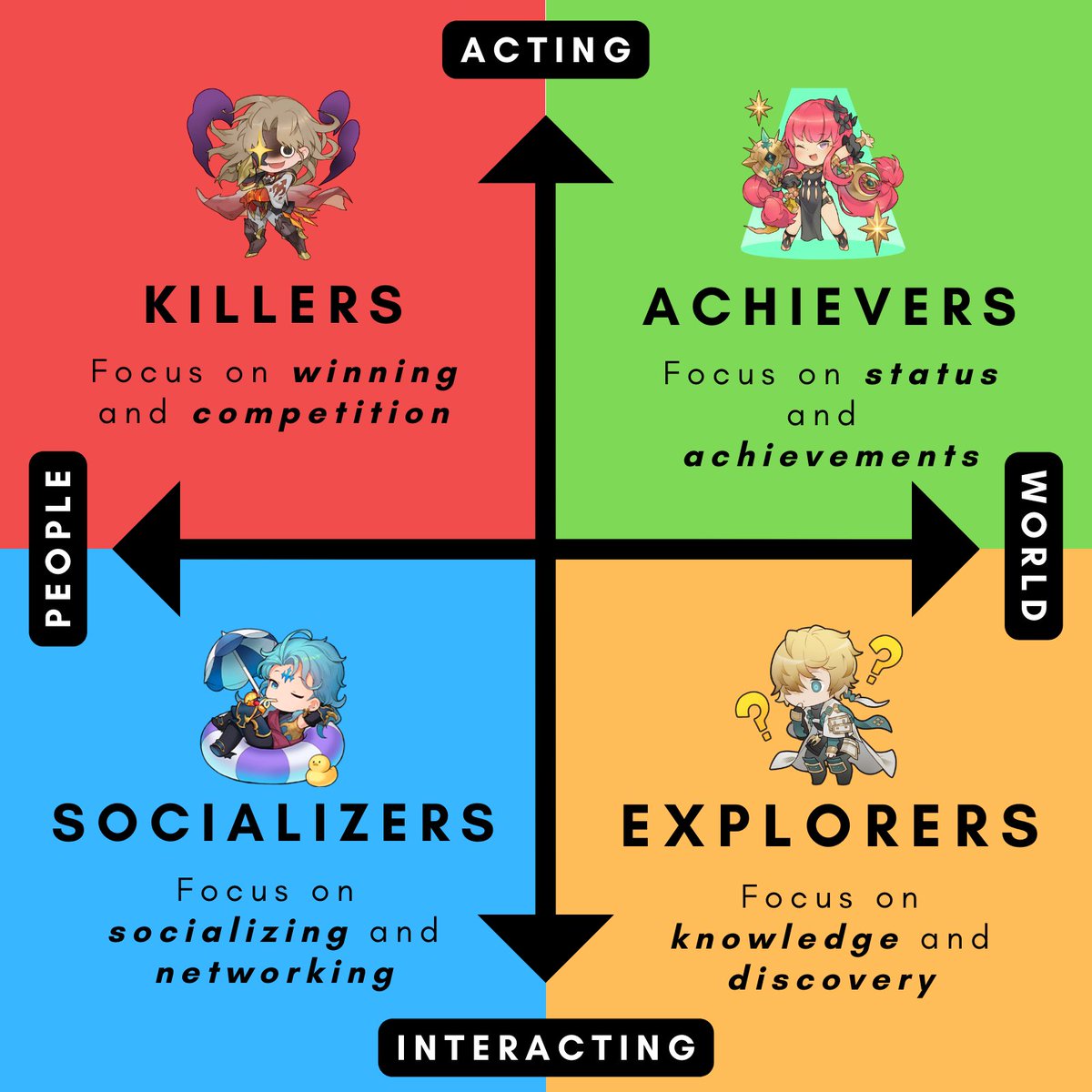
There are the Achievers who try to master everything there is to do within the game system. There are the Explorers that just want to go out and explore all the content in the world but aren't as focused on overcoming challenges. There are the Socializers who are really in the virtual world just to interact with each other, have conversations, and build companionship. And then there are the Killers - players that not only strive to reach the top, but take glory in beating down the competition in the process. Furthermore, they need to bask in their victories and be admired by all.
Kim's social action matrix
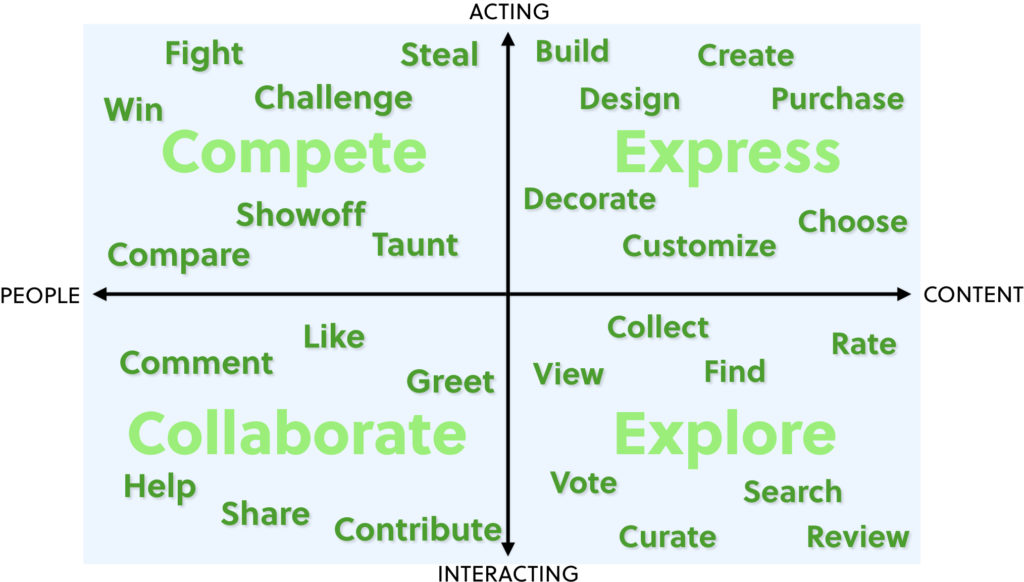
Andrzej Marczewski Gamification Player Types
Nicole Lazzaro's 4 Keys To Fun
The 4 Keys to Fun are: Hard Fun, Easy Fun, People Fun, and Serious Fun
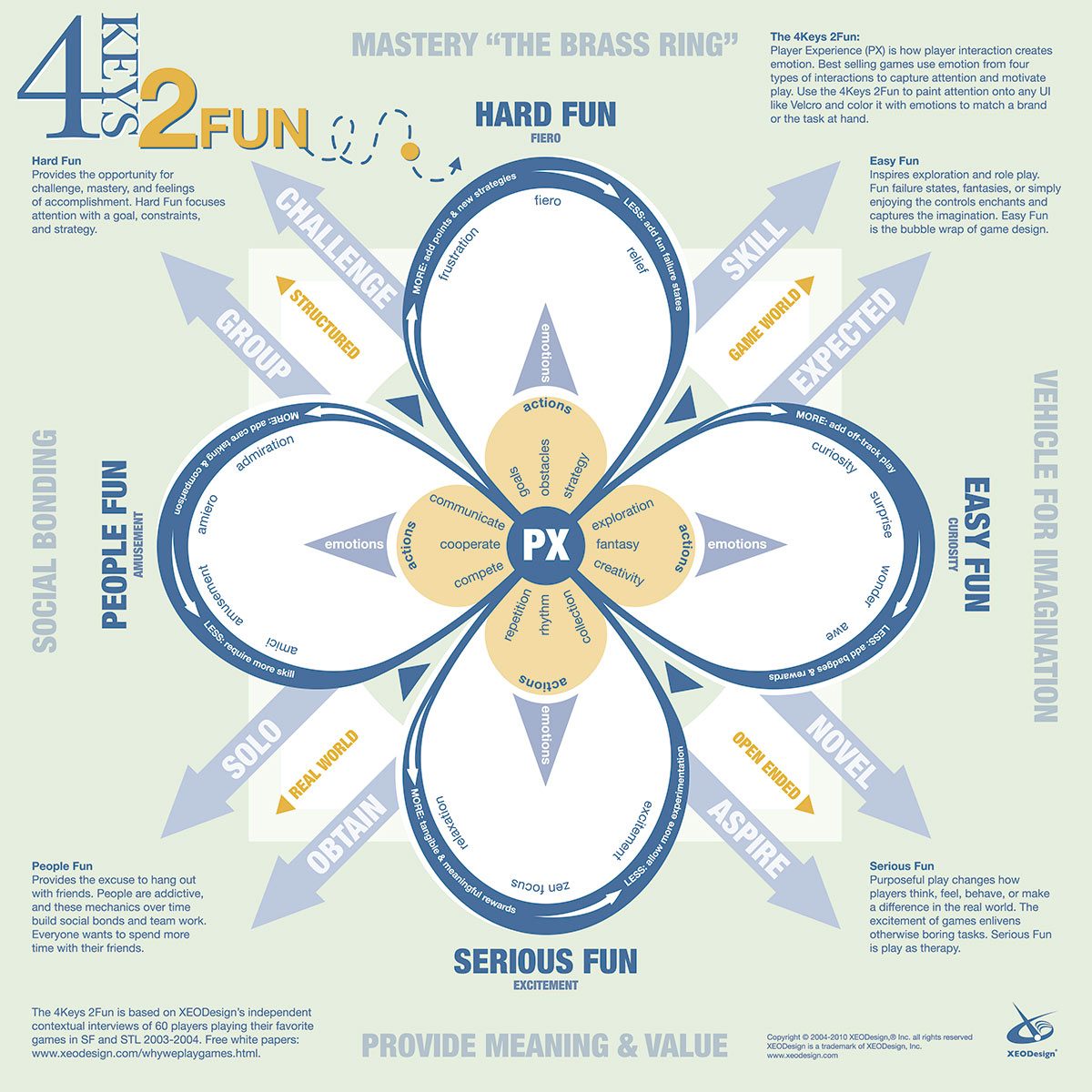
Hard Fun is a combination of Core Drive Scarcity & Impatience the difficulty and frustration of reaching the Win-State is what drive user motivation as well as the sense of achievement after accomplishing it.
Easy Fun is like a combination of Core Drive 3: Empowerment of Creativity & Feedback as well as Core Drive 7: Unpredictability and Curiosity. It's like playing with clay or Legos where you can do anything you want and can't really lose. Whatever you do you are winning because you are enjoying your time and seeing feedback from your creativity.
Serious Fun can be interpreted as a combination of Core Drive 1: Epic Meaning and Calling as well as Core Drive 4: Ownership and Possession. Epic Meaning & Calling is derived when one is engaged with an activity because they see its real impact in the world. In the case of activities that are exhilarating because they make you money every time you engage them, it is the result of Core Drive 4: Ownership & Possession.
People Fun is generally a combination of the obvious Core Drive 5: Social Influence & Relatedness and to some extent Core Drive 8: Loss & Avoidance. This is because when you are collaborating with people, you are under a bit more stress while you are trying to avoid looking bad, saying the wrong things, being shunned, or losing your position on leaderboard, Fun competition also extends out of People Fun, and the thrill of hide-and-seek or catch is often derived from a moderate level of Core Drive 8: Loss & Avoidance.
Mihaly Csikszentmihalyi's Flow Theory

The Flow theory illustrates that when the difficulty of a challenge is too high compared to a user's skill level, the result is a sense of anxiety which may compel the user to drop out quickly. Similarly, if the user's skill level is dramatically higher than the difficulty of the challenge, the user will feel bored and may also drop out.
Only when the user's skill level is balanced with the difficulty of the challenge, do they enter the state known as Flow. During Flow, users become completely focused. They "zone in" on their activities, loosing their sense of self, as well as loosing track of time. This is a moment of euphoria, excitement, and engagement.
The tricky thing here is that, more often than not, the player's skill level increases as time goes by. If the designer gives the exact same experience throughout the 4 Experience Phases (Discovery, Onboarding, Scaffolding, Endgame) the user quickly ends up being bored because they've outpaced the difficulty level.

Fogg Behavior Model
Motivation is how much the individual wants to take the action or obtain the desired outcome. Ability is how equipped the individual is in taking that action: in other words, how easy or convenient it is for the user to perform the action. The third factor is a Trigger, or something that reminds the user to take action.
Fogg proposes that every action you take is a result of these three components coming together. If any one of them is absent, there can be no action.
Jane McGonigal's Theories
McGonigal describes the four components behind how games make people better and more resilient: Epic Meaning, Urgent Optimism Blissful Productivity, and Social Fabric.
Chapter 16: Level I Octalysis in Action
There are generally two methods to use Octalysis:
The first method is to analyze existing products to determine their strengths and weaknesses for motivation toward the Desired Actions. It allows us to identify what type of motivation is weak 50 we can introduce new improvements, often in the form of Game Design Techniques, to the experience. This is typically called an Octalysis Audit.
The second method is to create a brand new experience based on Octalysis and the 8 Core Drives. Through a very systematic process, we can create an engaging experience that will fulfill the goals of the experience designer.
Let's first look at the former.
Octalysis Review of Facebook
The first step of utilizing Octalysis as a tool is to decipher all the motivation Core Drives that are present in an experience. In Chapter 3, we briefly looked at Facebook through the lenses of Octalysis. Let's take a slightly closer look using your new familiarity with the 8 Core Drives.

In general, Facebook is fairly strong in most of the Core Drives. hence the massive success it has today. At the center of Facebook there is Core Drive 5: Social Influence and Relatedness. People are consistently looking to stay connected with others to share their own experiences and check out what others are doing. Facebook deploys a great deal of Social Prodding, Social Treasures, and Conformity Anchors to create a more engaging experience.
On the other hand there is a high amount of Core Drive 7: Unpredictability and Curiosity in the experience. Every time a user goes on Facebook, they are looking for new and wondrous content that is worth viewing and sharing.
Hooked author Nir Eyal even implies that every time we go onto our Facebook (or Twitter) News Feeds, or when we "pull down" to refresh the News Feed updates, it's as if we are pulling the lever on a slot machine something he terms "Rewards of the Hunt."
Every time we commit the Desired Action, we are trying to see if we will be rewarded with more more interesting content. If we don't "win," we pull the lever to play again and see if we become luckier the next time.
There's also a strong sense of Core Drive 4: Ownership & Possession within Facebook. One of the core activities on Facebook is to accumulate and organize more photos of friends and experiences. In addition, since many people's Facebook profiles represent their social identity, there is a strong sense of ownership towards these profiles. True to Core Drive 4 principles, now there is an even stronger desire to organize and improve their profiles.
For some people, one of the joys of using Facebook is to constantly come up with creative and humorous things to say or content to share in order to get "Likes." This often utilizes Core Drive 3: Empowerment of Creativity & Feedback. The "Feedback" part of receiving likes is essential in any experience, as simply expressing creativity without receiving any feedback is actually a torturous experience.
Of course, when a person shares photos of their latest trip to Europe or a funny blog post that dozens or even hundreds of their friends are liking, they also feel a strong sense of Core Drive 2: Development & Accomplishment. This Left Brain White Hat Core Drive further makes a user feel good when they continue to commit the Desired Actions.
We also mentioned in Chapter 12 that there is a tremendous amount of Core Drive 8: Loss & Avoidance for Facebook, especially in the Endgame. This is because the Sunk Cost Prison prevents people from quitting due to all the time, friends, photos, experiences, messages, and game points accumulated on Facebook. Users are simply stuck with investing more of their time accumulating additional "valuables" that they are afraid to lose.
As mentioned in Chapter 3, the only two Core Drives that Facebook is lacking on are Core Drive 1: Epic Meaning & Calling, as well as Core Drive 6: Scarcity & Impatience. There is no real higher purpose that is greater than oneself when using Facebook. A rare exception is when people join Facebook Groups based on a higher mission or vision, such as some charity or cult groups. Of course, this type of motivation is certainly not dominant towards why people use Facebook, but only serves as an complementary experience alongside of Facebook.
We also mentioned how in the early days of Facebook, there was a tremendous amount of scarcity in the form of exclusivity as only students from a few selected universities like Harvard were allowed to join. During that time, Core Drive 6: Scarcity & Impatience was extremely high in the Discovery Phase, which also built up a strong sense of Elitism from Core Drive 1 during the Onboarding and Scaffolding Phases.
However, since Facebook opened up to everyone and their grandmothers, there is very little Core Drive 6 left. There isn't anything that you want but cannot have constantly being dangled in front of your face. Perhaps only when you are waiting for your friend to respond to your message or when Facebook has exclusive new features that are only offered to a small pool of users do you feel some sense of Core Drive 6. Oh yes, and that person you are stalking who refuses to accept your friend request and show you more pictures. I guess there is Core Drive 6 in that too, but it probably isn't the main "gameplay" experience of Facebook.
Of course, not having Core Drive 6 in this case is not a negative thing, because we learned that even though Core Drive 6 creates obsession by being Black Hat and Left Brain (Extrinsic Tendency), it is not ideal for long term engagement. If Facebook has already achieved strong engagement through other Core Drives (and earlier Core Drive 6 efforts), there is no need to add Core Drive 6 if it isn't trying to rapidly capture new users but to engage existing ones.
So based on the quick Level 1 Octalysis review above, we recognize that Facebook would be more successful if it had a greater element of Core Drive 1: Epic Meaning & Calling in it. People who are against Facebook often think of it is as a waste of time and a distraction to bigger, more important things. Plenty of people attempt to boycott or go on a "Facebook fast because they don't want to waste their life on "silly things. If Facebook could utilize its platform to get individuals to do more meaningful activities that help the world and contribute to society, then it would likely become even more engaging.
Of course, we see that Facebook already attempts to add in a thread of Core Drive 1 as they raise awareness and ask for donations to support natural disaster refugees. But those are usually one-off cases triggered by large world events that no one can ignore. It would be more meaningful if they build in more regular and streamlined experiences where users feel that every minute on Facebook actually contributes to the world. For instance, a top bar that continually displays an effort or group in less fortunate communities that is in dire need of help. It can also show a trigger button that allows people to donate their time or money to these causes.
Since the effort or group would change daily and would include details on exactly what they are going through, at the minimum people would feel more educated and aware of the world's problems each day they visit Facebook. Through massively increasing donations to groups, Facebook can truly say that they don't only change the world, but they also save the world as users login everyday.
Finally, it would likely benefit Facebook if it easily allowed people to find and seek help from mentors or homework buddies. This would make people think that being on Facebook is very "productive" and decrease their resistance of it.
The Score is a Smoke Screen
What's useful is using the Octalysis chart to determine which Core Drives are weak and need to be improved on, while understanding the nature of the dominant Core Drives in terms of being White/Black Hat and Left/Right Brain. The Octalysis Score itself is somewhat just fun and gimmicky. But since people keep asking, I thought I should share a bit on how I arrive at these numbers.
Generally, for each Core Drive, we assume a number between 0 to 10 based on "How strong does this Core Drive motivate towards the Desired Action."
- 0 Means that the Core Drive does not exist as a motivator within the experience. At the top end of the scale
- 10 usually means that it is impossible to improve the Core Drive further, and almost all individuals who become exposed to the Core Drive will take the Desired Action.
After that, I take the square of all eight numbers and add them together. This means that the highest possible Octalysis Score is 800 (Ten squared multiplied by eight), and the lowest is 0. In my own ratings, most successful games are above 350, and most non-game products are below 150. In fact, most products that aren't sensitive to Human-Focused Design fall below 50.
However, since the scoring is relatively subjective, different people will come up with different scores for the same product. When people ask me how do I know the exact numbers assigned to each motivation, I just say that it is based on an intuitive feel after experiencing the system. However, the exact numbers aren't really that useful as I mentioned earlier, as long as you are not far off. Core Drive a value of 2 or 3, as long as you know it is not a 7 or It really doesn't do anything to your design whether you give a based on their own sound judgements.
What's actually important in my mind is that you conceptually recognize things like: there is no unpredictability in your experience, or that you heavily rely on Black Hat Core Drives. Generally, just knowing which Core Drives are strong and which are weak can allow you to design appropriately for the experience, as opposed to spending precious time fussing over exact values.
One insight that can be derived out of the Octalysis Score formula, is that it is generally better being extremely strong in a few Core Drives, as opposed to having a little bit of everything. A score of 1 for all eight Core Drives will only result in an Octalysis Score of 8, whereas having two Core Drives that have the value of 9 will result in an Octalysis Score of 162. That is why it is so important to pick the right Core Drives that has the desired characteristics in your gamification design. If you are only going to pick a few Core Drives, you want to make sure that you are picking the most effective ones based on the specific scenario.
With that said, it is usually easier to improve on a Core Drive if it is completely lacking compared to ones that are already strong. It is usually fairly easy to add a little bit of unpredictability, a little bit of social, or a little bit of scarcity when there are none. But if there is already a high sense of Social Influence, it becomes much more difficult to further enhance that Core Drive. You usually need a true expert on that Core Drive doing a lot of design, research, and A/B Testing to push out the Core Drive from a theoretical 8 to a 9.
As a thinking exercise, a value of 10 for Core Drive 1: Epic Meaning & Calling should be something that is so epically meaningful that people are willing to die for it. Similarly, a value of 10 for Core Drive 8: Loss & Avoidance should reflect something so threatening that people are willing to kill for it. With that in mind, I'm going to imagine your employee engagement campaign is far away from having all 8s or 9s on each Core Drive.
Most systems in the market are Function-Focused, and the majority of products I have seen have 0 on most Core Drives and only 1 or 2 on a few Core Drives. Successful products have 3 to 4 on a few Core Drives and a few 8 to 9s. Industry-dominating products might have one or two 9s and even a 10, but that should rarely be assigned.
At the end of the day, if you use Octalysis just to make yourself feel good about what you are doing, then there is very little room to find better ways to improve the experience.
It's difficult to absorb a waterfall when your cup is too full.
Chapter 17: Designing a project from scratch with Octalysis
The Octalysis Strategy Dashboard
At the beginning of every gamification campaign, the first thing I do is to define five items:
- Business Metrics, which lead to Game Objective
- Users, which lead to Players
- Desired Actions, which lead to Win-States
- Feedback Mechanics, which lead to Triggers
- Incentives, which lead to Rewards
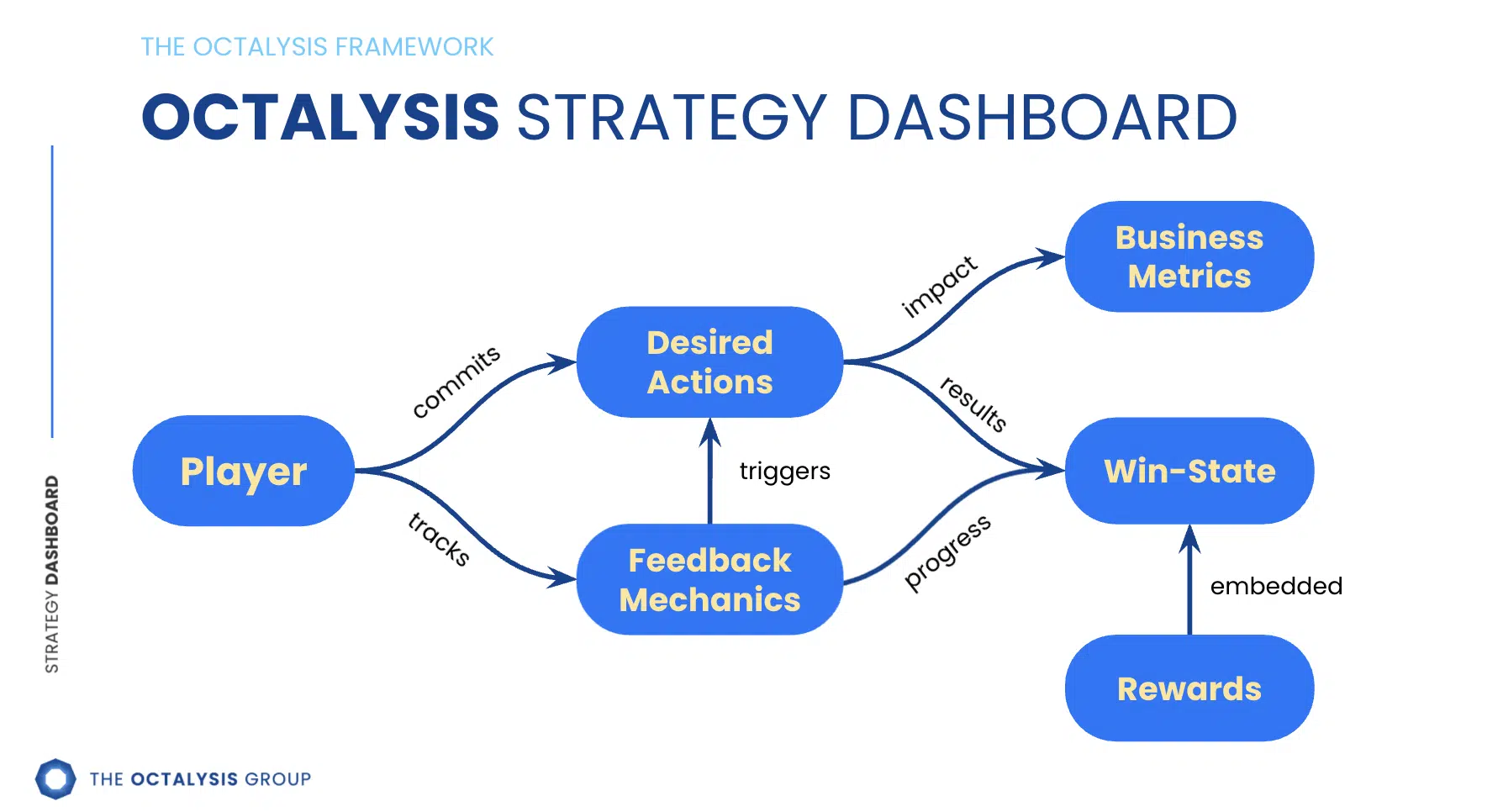
Define Business Metrics
Below are the Business Metrics for my new site, in order of the importance:
- Increase sign-ups to Octalysis Prime
- Increase book purchases
- Workshop orders
- Increase consulting leads via the website
- Increase Email subscriptions
- Increase Social shares
- Increase video views for TEDx or Beginners Guide to Gamification
- Increase page views for the Octalysis Framework
- Increase overall views on my website
Notice that this list is based on quantifiable metrics for what creates a successful website, and less on my social and personal aspirations. Also, the ones on top are final metrics that would make a project successful, while the ones on the bottom are more of a "means-to-an-end" type of metrics.
Many clients would ask me, "Well, don't we need many viewers on the website before we can get purchases?" That's true, but one is to enable the other, not the other way around. This means that the enabled is more important than the enabler.
On every interface, you will realize that you can improve many different Business Metrics, but you can only optimize for one Business Metric with the limited real-estate and user attention span. As a rule of thumb, the question to ask is, if my top three Business Metrics are doing amazingly well, while the other Business Metrics are doing modestly, would this project still be successful. Since my goal is to scale my knowledge transfer without being pinned down by client work (creating sustainable revenue), I think my list is appropriate.
The Business Metrics then become the Game Objective. If these quantifiable numbers go up, then the gamification campaign is successful. If these metrics do not go up, then the gamification campaign is a failure. No fluffy things that can't be A/B Tested 302 or held accountable for.
Define User Types
The next step is to define who are my target Users, which ultimately become Players in the system if the gamified designs work:
- Company employees that want to use gamification or behavioral design to improve their organizations
- Educators, nonprofits, and governments that want to use the knowledge to create a social impact
- Individuals who are passionate about gamification, games, or self-improvement
Define Desired Actions
The next step is to define the Desired Actions for the Users, which become Win-States once they commit to the actions. This is where we lay out all the little actions and steps that we want users to take in chronological order as part of a player journey.
Discovery Phase Desired Actions:
- Learn about Yu-kai's content through a conference, social media, or friend referral
- Land on an interesting content page within YukaiChou.com
- Click on the Octalysis link
Onboarding Phase Desired Actions:
- Skim the Octalysis article
- Share the Octalysis article with friends
- Watch Yu-kai's TEDx talk
- Click on Yu-kai's About Me Page.
- Fill in the email subscription form
Scaffolding Phase Desired Actions:
- Receive weekly emails on great content
- Open Weekly Emails
- Visit YukaiChou.com and read articles weekly
- Share articles with friends
- Participate in the Octalysis Explorers Facebook Group
- Buy and read Yu-kai's book
- Watch all free episodes of the Beginner's Guide to Gamification
- Sign up for Octalysis Workshops
- Obtain the Level 1 Octalysis Certificate
Endgame Phase Desired Actions:
- Sign up for Octalysis Prime
- Watch all 200 OP Videos as well as past workshop recordings
- Attend Weekly Office Hours
- Learn a new Game Technique and apply it every week
- Participate in exclusive discussion groups
- View weekly Octalysis case studies on websites, games, or products.
- Examine case studies and Showcases of actual member projects
- Become an Octalysis Licensee in their region
- Work directly with Yu-kai Chou and the Octalysis Group
Define Feedback Mechanics
Feedback Mechanics are information delivery mechanisms that communicate to the user that their actions are meaningful. It allows them to track their progress towards the Win-State, feel the urgency of time, understand the unpredictable nature of the experience, and more. All Feedback Mechanics should become Triggers that promote the Desired Actions further, or else it should not be there.
The first step to understand possible Feedback Mechanics is to define mediums of interaction and communication. These are all the places I am able to actually plant these Feedback Mechanics as well as Triggers:
- YukaiChou.com Website
- OctalysisGroup.com Website
- Yu-kai's Book (Hey you are here right now!)
- Email List
- Twitter and Facebook Group
- Speaker engagements
- Videos
- Workshops
The second step is to figure out what Feedback Mechanics I can insert into the site. This is what most people think about when they think "Gamification Design." These are the elements that allow communication of the 8 Core Drives that motivate behavior.
- Countdown Timers (Core Drives 6 and 8)
- Unlockable Content Page (Core Drive 3 and 6)
- Virtual Dice Roll Overlays (Core Drive 4 and 7)
- Little Tweet Bird on sidebar (Core Drives 5 and 7)
- Glowing Choice Overlay (Core Drives 2, 7)
- Embedded Videos (Core Drives 1, 5, and 7)
- Status Points via Captain Up or another Gamification Platform (Core Drives 2, 4, and 6)
- Hello Bar Top Display (Core Drives 1, 2, 6, and 7)
- Game Technique Collection Sets (Core Drives 2, 4, 6, and 7)
- Leaderboards via Captain Up (Core Drives 2, 5, 6, and 8)
- Certificates (Core Drives 2, 4, 5, and 6)
- Blog Posts to showcase members and announce information (Core Drives 1, 2, 5, 6, 7)
- Achievement Symbols via Captain Up (Core Drives 2, 3, 4, 6, and 7)
- Animated Popup Interfaces (Core Drives 1, 2, 5, 6, 8)
- Character Growth Charts (Core Drives 2, 3, 4, 5, 6, 8)
- Exchangeable Points that can be traded or redeemed (Core Drives 2, 3, 4, 5, 6, 7, 8)
As mentioned, this list is by no means exhaustive, but gives you a basic idea of the various elements I can use to insert game techniques as well as Core Drives to trigger users towards the Desired Actions. In a robust Strategy Dashboard this list may be a lot longer.
Incentives and Rewards
The last item to define in the Octalysis Strategy Dashboard is Rewards, which is what the experience designer can give users when they commit the Desired Actions and arrive at the Win-State. The list below is in the order of abundance to scarce based on what the reward giver can issue:
- Status Points
- Achievement Symbols
- Social Community
- Feeling of accomplishment and progression
- Featured on the Emails
- Easter Egg Surprises
- Featured on the website
- Free eBook
- Featured on the videos
- Free Physical Book
- Signed Physical Book
- Discount on Workshops
- Spend personal time with Yu-kai
- Opportunity to work with Yu-kai
- Octalysis License
Beyond rewards, I also want to make Octalysis Prime itself rewarding and meaningful. Based on the brainstorming above, below are the programs I can provide once someone signs up to Octalysis Prime:
- Weekly Office Hours
- Chapter-by-Chapter Takeaways for books on Game Design, Motivational Psychology, and Behavioral Economics. These include books that were referenced a lot in this book and many more
- Access to all Beginner's Guide to Gamification videos and other workshop recordings. Since later videos will be locked, access to all videos would be a reward.
- 100% off discounts (free) to every future workshop, which can easily be thousands of dollars of savings as long as members attend one
- Weekly video/post about a new game technique, and encourage members to use it in their surrounding environment
- Accountability buddy to discuss the week's Game Technique usage
- Practical use-case teaching: how to negotiate a higher salary, how to use Black Hat to close deals, how to do parenting more effectively, how to deal with your coworkers, etc.
- Exclusive discussion groups
- Weekly case studies on Octalysis
- Weekly analysis of a website, game or product.
- Analysis of recent popular products and why they became successful
- Game technique combinations teaching
- The dynamic relationships between Core Drives
- Case studies and Showcase of actual member projects
- Live Streaming and Recordings of me researching on new games
Level I Octalysis Ideation Process
Once the Octalysis Strategy Dashboard is fully defined, the next step is to go through the 8 Core Drives and come up with new ideas that appeal to people's 8 Core Drives toward the Desired Actions.
Core Drive 1: Epic Meaning & Calling
- Messages (via Hello Bar and blog posts) that show users that they can transform their lives into something greater through the Octalysis movement. Earlier we mentioned that for Core Drive 1 to work, believability is very important. I wholeheartedly believe in my value proposition, and so the key is to communicate that in a believable manner.
- Showcase pro bono projects we do for world changing causes such as our campaigns with nonprofits to save the Amazon Rainforest. (Did you know at the current rate, the Amazon Rainforest will be completely gone within forty years?)
- Establish a sense of Elitism through the concept of "Good Gamification" as opposed to the subpar implementations that currently exist in the market.
- This idea just came to me as I was editing this chapter: for our Octalysis Prime offers, we could also do a "Save the World Weekly" campaign where each week we take one global problem and I showcase how to use Octalysis to design something that improves or solves the issue. At this point in my own design process, I would go up and add this to the offerings within Octalysis Prime.
Core Drive 2: Development & Accomplishment
- Clear design that never lets users feel confused about what is the Desired Action. Use a combination of Glowing Choices and Desert Oasis.
- Constantly let users feel that they made the smartest choice being part of the Octalysis Prime program. Always provide so much value that every time they log in, they hit a delightful Win-State.
- Octalysis Prime members can increase their Knowledge Scores by viewing more content, and attending more sessions. High Knowledge Score members can earn certificates that will make a difference on their resumes.
- Perhaps extending beyond that, every subscribed user can start off with an empty Octalysis shape as their profile. As they increase their knowledge or activity in certain fields, that Core Drive will be visually expanded. In this case, some members who choose to engage all the Social Influence content as well as participate in community events, can be shown as specialists in Core Drive 5: Social Influence & Relatedness. This ends up being one of the core concepts that will be elaborated on later.
Core Drive 3: Empowerment of Creativity & Feedback
- A new and upgraded Octalysis Tool that people can use to design and analyze their own projects. At this point, I would go back to "Desired Actions" and add "Use Octalysis tool on own projects" into the Scaffolding Phase. Always keep in mind that the Octalysis Strategy Dashboard is a living document that grows based on more refined thinking.
- Member submission of their own work and receive feedback during Office Hours.
- Member voting on what products or campaigns 1 analyze next. This places a small sense of agency into the users' hands. Remember, Core Drive 3 is all about turning passive observers into active players.
- Chain Combos: if users sign up to Octalysis Prime as well as obtained other Achievement symbols on my site, they can obtain greater rewards that compound. During the designing process, some ideas are vague. That's okay. Just know what you would ideally like to put into the experience and often you will find a great refined model later on.
- Each week, members will learn a new Game Technique that they will be encouraged to use in their own actual projects that week. They can share their experience with their accountability buddies or the community and gain feedback.
- "Specialists" in a certain Core Drive will be allowed to host sessions themselves and share their experience and research on certain topics.
- Monthly "Octalysis Design Challenges" where the community competes in solving or improving the designs of other organizations - many non-profits for a good cause.
Core Drive 4: Ownership & Possession & Feedback
- Collection Sets: Allow users to collect more Game Techniques, which will become the key to some higher level Octalysis magic later on.
- Earn the Level 1 Octalysis Certificate as well as other concrete career-boosting items.
- Use Easter Egg pop-ups to randomly give browsing users a free book, even signed. Remember, if you need to give out a reward, you can always go back to the Rewards/Incentives section of the Strategy Dashboard and pick from the list there. That's your arsenal to create delightful experiences.
- Show users how the Octalysis knowledge can benefit their health, productivity, happiness, and income. Sometimes people may view my work on Octalysis as too academic or theoretical, and so it's only for hardcore product managers or behavioral designers. However, it is important to communicate that this knowledge quickly translates to things that impact everyone into their daily lives, from negotiating a higher salary or raising funding for their organization, all the way to becoming a better parent
- A Personal Octalysis Report, where the Core Drives that motivate a person more are revealed - with tips and advice on how to use this knowledge.
- Exchangeable Points. Perhaps have some type of "in-game currency," perhaps called "Chou Coins." (Okay, don't laugh. This is just a brainstorming name, alright?) Users can accumulate Chou Coins and use them to unlock more scarce rewards and experiences within the Octalysis Prime experience.
Core Drive 5: Social Influence & Relatedness
- Entry Level Watercooler: Octalysis Explorers Facebook Group.
- Premium: OP Mastermind - OP Members can discuss advanced topics and keep each other accountable via a private Slack Group.
- Group Quest: Only after X users receiving the the Octalysis Certificate will the next level be opened. This will incentivize people to invite their friends to take on the challenge too.
- "Success Buddies" - Accountability and practice buddies for Octalysis activities, enabling peer-mentoring.
- Top Members showcase display. I don't want this to be a real competitive leaderboard, so probably won't show specific stats of the players nor their ranks, but merely randomly display members in the top 10%.
- Further Conformity Anchors, showing regional group scores may be interesting. Again, this incentivizes people to invite their friends to participate and improve the group rankings. What type of group rewards are to be given will need to be flushed out later.
- Use Twitter #hashtags for Octalysis (such as #OctalysisBook) to display a sense of relatedness between users. This can also work involving Instagram where every time someone sees an ad they identify the Core Drives in it on Instagram with #Octalysis labels.
- If I ultimately decide to go with the Chou Coins idea, then it opens up a new set of potential rewards and the ability to introduce Social Treasures. Perhaps every day users have an opportunity to "tip" Chou Coins to someone they appreciate in the community, with each Chou Coin becoming two coins when tipped (to a certain limit). Generosity takes a person further than self-consumption.
Core Drive 6: Scarcity & Impatience
- We want subscribers to feel committed. There should still be an admission process for signing up. But it can't be too difficult, to avoid creating any procrastination. Perhaps when they sign up to Octalysis Prime, they have to answer a question like, "In five sentences or less, share what you plan to do with the knowledge obtained from the membership." Of course, people who obviously have malicious intents would also be rejected, but this is mostly to set a barrier of commitment for those that want to be part of the war against boredom.
- Dangling: if there is additional content that members need to unlock or "earn," display lock-like feedback mechanics and provide users info on exactly how to unlock it. Even when people join Octalysis Prime, still make it a journey where things are paced out instead of overwhelming the user at once.
- Of course, a big part of Core Drive 6 design is making things challenging to the point where there is an actual sense of accomplishment (Core Drive 2) when completed. It is important to still make the Octalysis Certificates and other high-end rewards very difficult to obtain, That way they actually symbolize something meaningful.
- A Torture Break, Anchored Juxtaposition and Evanescent Opportunity Combo: there will always be content that is only reserved for premium members, but some of the new content
- I create for Octlaysis Prime will be free on my blog for one or three days with a displayed countdown timer. After three days, it will be locked up for OP members only. However, a new Timer will appear, initiating a one year countdown. After a full year, the content will become publicly available - indefinitely. This means that if people want some of the Premium content and don't feel like paying, they either need to have enough diligence to be on my blog every day (another Desired Action), or have enough patience to wait an entire year before it comes out. As mentioned before, most free-to-play games monetize based on exchanging people's time/patience with money.
- As mentioned before, since I want to have enough bandwidth to create all 90 Beginner's Guide to Gamification videos, later episodes will be locked and only accessible to OP members. Many viewers have also been collecting a set of secret key-words. My plan is that those with all the keywords from the free videos will get 50% off for the monthly subscription plan. People who then collect all of the keywords after that will get an amazing reward worth remembering.
- Create Daily 1-Hour Group Quests to get people to return often. The idea is to see if I could somehow pull off a daily activity, where if enough people take a certain Desired Action within a one hour period, something amazing happens. This requires further thinking and designing.
Core Drive 7: Unpredictability & Curiosity
- Goofy and unpredictable videos in The Beginner's Guide to Gamification. Part of the basic set of what's already in the current site is the Core Drive 7 strategy of constantly changing backgrounds for each sentence. It is a bit shaky for some people, but many people comment that despite their short attention spans, they always finish my videos because they want to see where I appear next. For the newer premium videos, I plan to stand still while I switch scenes so my viewers won't feel dizzy anymore.
- Easter Egg Game Technique captures. When a person explores Octalysis Prime, random creatures will appear that each represent a Game Design Technique. If you defeat the creature with the knowledge you learned on the site, then it drops that Game Design Technique for you to collect.
- Set Mystery Boxes when users commit large Desired Actions. Whenever the user does a significant Desired Action, the dice rolling feedback mechanics can appear and certain rewards will be given. The variability of the rewards, assuming the Desired Action is not drawn out, may increase strong engagement with the experience.
Core Drive 8: Loss & Avoidance
- FOMO Punch. Remind users what they would lose every day when they don't have this Octalysis knowledge to employ within their lives.
- Addressing an Anti Core Drive: give users a guaranteed full refund if they did not obtain justified value from the service.
- The character growth chart and Chou Coins, if implemented, would make it a bit harder for people to quit the system.
- However, I'm generally not interested in designing for the Sunk Cost Prison since I don't want anyone to think that they can't quit my site simply because they will lose many things that they have accumulated. If I am not delivering awesome value to my users, I don't feel comfortable collecting a single dollar.
Repeating the Octalysis Process
Once you go through the 8 Core Drives, don't stop there. Do it again. More sophisticated ideas will often flow out. As a real example, after a few cycles of the process above, I derived a new type of player progress journey. This player journey intricately involves multiple Core Drives and could be a fun engaging experience throughout the Scaffolding and Endgame phases. The new concept is the below:
If possible, each Desired Action is assigned different Core Drives based on what a user can learn from those actions. For instance, participating in the community and helping others will increase a user's Core Drive 5 stats, while playing with the Octalysis Tool and coming up with creative solutions, will increases their Core Drive 3 stats.
Each player will start off with a basic octagon shape. Their octagon will eventually expand in the direction or directions where the corresponding Core Drives are being "leveled-up." Reading my Chapter-by-Chapter Takeaways from Daniel Pink's Drive will get experience points in Core Drives 1, 2, and 3, while taking advantage of a promotion at the very last minute will obtain Core Drive 8 points.
When each Core Drive levels up to a certain degree, specific boosters/power-ups and rewards will take place.
Here is a preliminary thought on how different leveled-up Core Drives might grant different benefits:
Core Drive 1: If a user reaches Level 10 in "Meaning", they can vote for which non-profit 3% of Octalysis Prime revenue goes to.
Core Drive 2: If a user reaches level 10 in "Accomplishment," her profile page will turn into a gold color that is nicely textured and displayed to everyone you interact with. Her profile photo will have nice gold frames wherever she goes on the site to show off her status Core Drive 3: The ability to start researching and hosting your own sessions to the community, enabling you to express a great deal of creativity and receive immediate feedback. It will also allow you to build your personal brand.
Core Drive 4: Earn more Chou Coins for your Desired Actions.
Perhaps every Desired Actions can earn a certain amount of Chou Coins to unlock more content. However, if your Core Drive 4 is leveled-up, you receive a 30% bonus on each Desired Action you perform.
Core Drive 5: The ability to moderate and lead the community. You will be able to mentor people, give support, perhaps be able to give out Social Treasures, and more. This will improve your ability to get helped from the community when you need it.
Core Drive 6: Penetrate through unlocked content faster. As an example, perhaps require less Chou Coins to unlock new content.
Core Drive 7: Unlock additional lucky dice rolls to obtain rewards such as Chou Coins. Perhaps every user gets a lucky dice roll every day or when they complete the Desired Actions. But people who have leveled-up their Core Drive 7 gets two lucky dice rolls to increase their odds of winning.
Core Drive 8: If a user reaches Level 10 in "Avoidance," his monthly membership fees will be deducted by 40%. That way they masterly skills of "Avoiding" paying fees suddenly come into effect.
With this preliminary concept, there is a strong reason for all the users to execute the Desired Actions while finding their own paths to level up in the experience. Socializers will get socializer benefits, while Achievers will get achiever status. Each can play the game differently.
Summary of Level 1 Octalysis in Action
As you can see, lots of new ideas can come out by thinking through the 8 Core Drives, setting a guiding roadmap to design for an engaging experience. Of course, the designing work is far from over.
When designing, it's great when lots of ideas go into the top of a brainstorming funnel. However, it is usually a bad sign when lots of ideas come out of the funnel towards implementation because it shows a lack of focus. Most companies can only implement a subset of the creative ideas in a timely manner.
At the end of the day, Octalysis allows you to ask the right questions for your experience design, but you still need to answer them in a sophisticated and empathetic way. If you just treat Octalysis as a checklist, your design will only have the shell but not the essence within. Only if you utilize your creative intuition as well as sensitive empathy skills throughout the process will you come up with concepts that truly help increase all your Business Metrics and allow users to enjoy the entire process from the Discovery Phase all the way to the Endgame.